Category Archives: Wondering - Page 12

The Music Biz

The last few days, I’ve been adding additional metadata from my CDs into my ripped files so I can identify them better when logging them in Discogs.  As I was going through each of my CDs, I was logging the record label, the barcode and the catalog number.  As I was doing this, I had a few thoughts.

The first thought I had was noticing that when an artist or band would change record labels, their defining sound would usually radically change, and usually for the worse.  Most cases where this happened would be leaving a major label like Geffen and going to a tiny label like Ray’s Music Records.  There are some cases where an artist would change from a megalabel to a boutique label, like from EMI to Relativity or Magna Carta and although their sound would change, it would still be recognizable.

This got me thinking about how much influence a label has over an album.  Maybe it’s because the larger labels have a stable of high-quality producers that mold the artist’s sound with a heavier hand?  When the band leaves, they either self-produce or are provided a producer from their new label that has a different concept, so maybe that is the reason for the drastic change?

So maybe there is a distinct advantage to being signed on a big label, despite the massive disadvantages that go along with it.  And that was my second thought.  When I look up an album on Discogs and I see there are over 100 different releases of it, I get angry.  I can understand that there may be reasons for an album to be released on different labels in different countries.  I also can understand if a label gets bought out by a different one.  But when I see the album sold by multiple companies, that irks me.  That comes down to who owns the rights to the music.

One time, I picked up a book written by a musician about her story and experiences as an artist.  I didn’t read much of it, but I happened on a passage saying that if a contract ever uses the phrase “in perpetuity” to run away and don’t look back.  The meaning of that term is that the record label owns your work forever.  They can do whatever they want with it: sell it off, license it (whore it out to multiple people), or keep it locked away in spite of huge demand.  Whatever they want.  And that’s what really angers me about the music industry – the idea that the artists and their work belong to them.

It’s not an arrangement like, “You make your music, we’ll help sell it and we’ll take a percentage of the sales for doing that for you.”  It’s more like, “You make music for us, we’ll sell it and give you a percentage of the sales for your efforts.”  And for some long-running acts, you see this terrible situation where they’ve been released from their contract on one label, moved on to another, and the original label starts rehashing all their old songs into different compilations and collector’s editions.  That ends up cheapening the artist’s  image.  I’ve seen artists that have 10 albums and 40 compilations.  How fair is that to the artist?

Finding The Unexpected

My new section here on my blog for the MCA Master Series has all its images backed by my Flickr account.  I’m keeping an album on Flickr for any CD covers that are particularly rare or aren’t available in high quality.  Like I semi-mentioned in my previous post, albums can be re-released by different labels or even by the same label and they may change or update the artwork.  This is rather true for some of the MCA Master Series albums where the artist wants to break free from the consistent design imposed by the label.  So in that case, I feel it’s important to preserve the album art consistent with the version I have, because whenever I search online for the artwork, I get the newest revision.

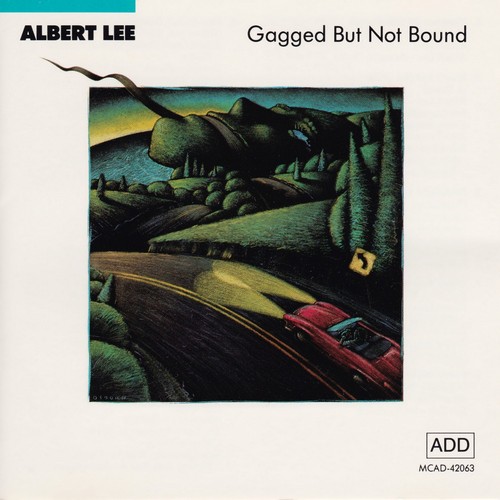
So, on Flickr, I have all my MCA Master Series covers, along with some others as I’ve been scanning them.  As I was scrolling through the album, I noticed one of the covers had an abnormally high view count relative to my others.  Like a 100:1 difference.  The cover was Albert Lee – Gagged But Not Bound:

So I started to do some research.  I wanted to know who found my scan and what they thought of it, good or bad.  I looked for any Albert Lee fan sites/forums.  I looked for album art blogs, I couldn’t find anything.  I thought maybe it had ended up in Flickr’s Interesting list or maybe a group there.  Nope.

I didn’t have a Flickr Pro account, so I couldn’t see any advanced statistics, like where the traffic was coming from.  After a couple days of searching in vain, I broke down and paid for a Flickr Pro account.  And of course, the stats weren’t historical.  I had to wait for more people to view the image.

A couple days later, I checked up on it and sure enough, I had stats – useful stats.  The cover was being found through Flickr search, not from an external website or search engine.  That’s odd.  Why would they find that image and not any of my others.  Then I drilled in deeper and looked at the keywords being searched.  Oh.

I guess people use Flickr to search for erotic bondage pictures.  Photos involving people being “gagged” and “bound”.  And, among their expected search results, my CD cover scan is in there, and it’s intriguing enough for them to click on.  On one hand, I’m disappointed my stuff is being found in a search for a fetish, and on the other hand, I think it’s surprising that my stuff is actually interesting enough to be viewed in that context.

Nice

Today at lunch, I parked my car and was walking to the restaurant and a women heading the other way called to me, “I like your car!”  I turned and said “thank you” and kept going.  Now, after a short reflection, there’s a lot I have to say about this.

The first reaction I suppose people would have is, “She was totally into you!” or in a more modern phraseology, “She wants the D!”  Or even at a more simple level, my car was an icebreaker.  Let me share a story.  This is from my last dating experience (and I expect it to be my last since I have an awesome GF and I’m not going through that hell again in these modern times).  The dating site I was using had a feature that would anonymously poll users to find the best picture from your collection that you could use as your profile picture.  Of the ones I had uploaded, the highest-rated photo was of my car.  Isn’t that a crushing bit of knowledge to have?  The best picture of me is not a picture of me.

So excuse me if I’m a little sensitive on this particular matter.  There’s a huge difference between saying “Nice car!” and “Cute baby!”  The latter is something that you made.  It’s unique.  The former is something you bought.  Anyone can buy it.  There’s also a difference between a pedestrian person saying “nice car!” and an enthusiast saying “nice rims” or “nice mods”.  The enthusiast’s knowledge and expertise lend credibility to his compliment and makes the compliment more directed at you.

Finally, there’s a huge difference between “I like your car” and “I like your taste in cars.”  Is the difference that obvious?  If I hear the first, I don’t even give it a second thought.  If I heard the second, it would be a conversation-starter.  So, here’s a quick tip for you single and searching people out there.  If you see someone you are interested in, don’t compliment the things they have, compliment them on their choice of things they have.  After all, you want to be one of the things they choose, right?

FML (Failure: My Learning)

I read a book recently: How to Fail at Almost Everything and Still Win Big by Scott Adams.  It’s a good book and has made me think about things I do and has led to some behavioral changes already.

One of the things it made me think about was how I learn.  There’s a common saying when discussing different teaching methods that people learn in different ways.  They say some learn by hearing, some by reading, and some by doing.  In my particular case, I learn by doing.  But more importantly, I learn by failing.

For a very common personal example, when I am learning programming, it’s not enough for me to duplicate an example from a book and see it in action.  I will usually make the example my own – renaming variables, eliminating some pieces I feel are extraneous, and so on.  If it doesn’t work, great!  If it still works, I keep tweaking it until it breaks.  Then I begin the process of understanding why it doesn’t work.

To me, the how isn’t as important as the why.  I have the need to understand what the important parts are, so when I am creating my own version, I know what is flexible and what is not.  Or when I am looking at other’s broken code, I can focus on the important parts.  I think this is an important part of understanding.  I say many times that if something works perfectly the first time, you haven’t learned anything from the exercise.  Failing is a very important part of my learning process.

This sort of means I am suited to do more creative work.  I mean, I would be a pretty poor doctor (even though I am a great troubleshooter).  More like Dr. House, I would have to nearly kill each patient until I figured out what the proper solution was.  It also means I’m pretty damn poor at math.  My approach to solving a math problem is to start with a formula with known working inputs and output, then test it with many different inputs and verify that the output is as I want.  This is why I don’t do game programming.

Dining Philosophy As Work Philosophy

Some time ago, I had written about a blog post about my dining out habits, or more so, about how I just eat out every meal.  Lately, I’ve gotten a little better about that and started cooking some stuff at home.  I got to the point where I said, “I can cook a damn hamburger seven days a week” and started doing it.

But anyway, one of the guidelines I lived by when eating out was, “Eat the expensive parts.”  Get your money’s worth is what I was trying to express.  When discussing job duties with the GF recently, especially when faced with overwhelming amounts of work to be done, I brought up the common phrase, “How do you eat an elephant?  (One bite at a time.)”  The convergence of these two bits of guidance was immediately obvious.

So, if you have an elephant to eat, where do you start?  You eat the most expensive pieces first.  So when consuming, make sure to get your money’s worth.  When providing, make sure your efforts have the greatest impact.

You Change, You Lose

Today, I noticed a restaurant I used to visit closed up.  it got me thinking about all the places that I stopped going to because they changed in some way for the worse.  I keep telling myself that the one thing I wish I could express to the younger generation is that they have no idea what they missed out on, when fast food used to taste great.  But anyway, these are my reflections:

Burger King:  They used to have the best fries up until about 1996.  They were so good, I’d get a large and another medium with my meal.  Then this big craze of “coated” fries happened and everyone’s fries started sucking.  Later, in the “Great Recession” of 2007, they decimated the double cheeseburger.  That used to be single greatest value on the whole menu, then they turned the patties into tiny silver dollars.  Now, if I ever go there, I have to get two double cheeseburgers and the smallest fries available.  That’s maybe twice a year.

Wendy’s:  My first experience with Wendy’s was a long time ago, maybe early-to-mid-80’s.  It was amazing.  I had to wait for a long time for one to open near me, but when it did, I ate there all the time.  Then I moved away and I’m not sure if it was an operational coincidence or a geographical difference, but they stopped pressing their burgers.  This made the patty a thick cube and significantly altered the taste.  I tried to work through it, but ended up going less and less frequently.  Their fries have also declined in taste, so it’s now a very infrequent visit.  I feel bad because my nearest store just did a complete new and modern rebuild and I don’t even go there.  The parking lot is empty every time I drive by, too.

Longhorn:  I discovered their burgers maybe around 2003 on a vacation and ate them religiously until only a couple years ago when they changed their buns to some Brioch crap.  I ate them much less frequently, then just gave up and started eating the 6oz steak instead.  Longhorn’s fries have declined in taste lately, too.  I used to eat there multiple times a week, and now it’s maybe every other week.

Chilis:  I used to eat there a lot starting around 2005, then they changed their chili recipe from a Texas Red to something heavy on the beans (i.e. cheaper).  I didn’t eat chili, but my SO at the time did, so we never went back.  Fast forward a few years, new SO and new weekly+ enjoyment of Chilis burgers.  Until recently when they changed their buns to some Potato bun crap.  Seriously, it is like eating latex foam.

Green Iguana:  I discovered this place maybe in 2012.  It was somewhat close to work and they had great burgers and fries.  Then one day, they were closed.  Turns out they were moving to a new location.  After patiently waiting, I hit them up soon after they opened.  But it wasn’t the same.  They changed their fries and changed from Coke to Pepsi, and overall wasn’t just as good.  I went there twice, then stopped.  They just closed down; maybe they lasted a year at their new location.  There are other locations that I could and would be willing to try if I was near them.

Your Ecosystem Is The Poison You’ve Picked

There will never be agreement and acceptance no matter what ecosystem you have chosen.  Which is it?  Apple, Google, or Microsoft?  Anyone that tries to span multiple ecosystems is going to have a tremendous time trying to keep everything in sync between them.  And for all the wonder an ecosystem brings, it’s also sad.

The Internet was created to provide a neutral environment for services.  The first instance of the “walled garden” was AOL.  “Walled gardens” existed  before the Internet (Compuserve, Dephi, etc.), but that was out of necessity.  AOL came and built a community within a larger community.  And for quite a while, they prospered.  But people started getting savvy and peeking over the walls more and more.  Eventually, they wanted to experience the rest of the world.

The next attempt at corralling users was through authentication.  Why do you need to have so many usernames and passwords when you could just use one?  Microsoft was huge on that concept, with Passport, then Windows Live, now it’s just your Microsoft (or Windows) account.  But it never caught on, right?  Well, not until Facebook started providing the same shared login functionality.

The big battleground now is with mobile devices.  You either have iOS, Android, or Windows Phone, which means you have either an Apple account, Google account, or Microsoft account.  That’s how your data gets stored, backed up, and shared.  Facebook was rumored for a long time to be making a mobile device, but they don’t have an operating system to back it up, so it’s unlikely that would happen.  Amazon tried it and didn’t make it.

But back to the main point, what if you are a Windows user and have an iPhone?  Why wouldn’t you want to have the full integrated experience of the Apple world and get a Mac?  Conversely, why not have the full integrated experience with the Windows phone?  Why not be platform agnostic and just use Google’s services from either OS with an Android phone?

I guess what I’m trying to get across is that the concept of integration is too tightly aligned with the concept of lock-in.  And being locked in to any platform is never a good idea.  I’m looking at you, Facebook.

Birthday Wishes

On a popular image site, I saw a captured text message thread of a person who was receiving texts for a wrong number.  The texts were wishing him a happy birthday and asking what he wanted for his present.  Deciding to prank the real recipient, he asked for a bunch of One Direction merchandise.  The result could be taken as funny or cruel, depending on your sympathy for random strangers.  Some say his birthday was “ruined”.

There’s where I perk up my antennae.  I remember the day my birthday was “ruined” and I never celebrated my birthday since.  In hindsight, it was pretty ridiculous that I got all upset over the situation, and at the same time, I now feel it was ridiculous to make a big deal out of my birthday anyway.

There are some people that think their birthday is some magical day and they put a whole lot of effort into it and have very high expectations.  Since I’ve given up on that celebration, I don’t see the value in it.  It definitely increases the chance of disappointment, and why would you want that to happen on a day that you hold in such high regard?  Not to mention, this belief puts undue stress on the people who have to make your day “happen”.

It’s kind of my personal philosophy to stay out of everyone’s way and not be a burden on anyone.  That makes me sound like a hermit, and I’m not exactly opposed to that label.  I’ve become generally self-sufficient.  When asked what I want for my birthday (or Christmas, for that matter), I don’t have an answer.  There’s nothing really that I want or need that I can’t get for myself.  So the incredibly few people who insist on celebrating these events with me are always struggling for ideas.  It reminds me of me trying to buy gifts for my dad.

“This” Is Not Good.

I write Windows software for a living and as a hobby.  When Windows 8 came out and they introduced the new Metro/Modern app paradigm, I was unconvinced.  I never investigated why I felt that way, but I felt so strongly about it that I didn’t even want to invest the time to figure it out.

I’ve recently had another burst of motivation to get certified in my programming skills, and the training I’ve been studying involves these new-style apps.  For a while, I was interested, but then as I saw and learned more, I got less interested.

I think the same reason I dislike the modern apps is the same reason I don’t use any apps on my phone.  And that’s not surprising since they are essentially the same thing.  The problem I have with the apps is they operate in a singular focus at all times.  You start at a high level, you dive in, then you back out and do it again.  The bottom line is, this will not work for nearly all business applications and it won’t work for many productivity applications.

The official training is as much marketing as it is instructional, and I understand that.  As a developer, you have to sell the reasons for creating an application in a certain way.  One of the marketing themes is that the user should be “immersed” in the application.  There should be no chrome and no distractions.  I don’t see how this squares up with business data, which is primarily a collection of relations.

In a business app, you can have an “Order”.  But that order has a related customer and products.  That customer has a related company and contacts and previous purchases, and each of those products has related inventory, cost information, purchase history, and so on.  How can you “immerse” the user in an “Order”?  If the user then wants to see the customer information, now you have to immerse the user in a “Customer”, despite the context that the focus is still an Order and you are viewing the Customer in the context of that Order.  Ditto with viewing any Product Details.

And I think that’s the part that bothers me to the point that I can’t even begin to want to understand it.  A Modern app feels like, “You are working on this. *click* Now you are working on this.  Do not think about what you were working on, this is what you are working on.”  In fact, the immediacy of “this” sums up my dislike of Modern apps.

When Windows 10 was previewed, I was excited that Modern apps could be run in windows instead of full-screen.  It didn’t dawn on me at the time that windowed Modern apps didn’t fix the root problem that the application itself was single-screen.  Even if you think about a lowly web application, even they can open pop-up windows.  And by that, I mean real windows, not just frames in the main window.

It all just feels like trying to sell a limitation as “the best way”.  We can’t do something that way, but that’s not important, because this is the best way to do it.  It’s similar to a situation I have at work on the application I help write.  The user can’t have more than one screen open at a time because of the way the form controls talk to the parent form.  It doesn’t have to be that way, but the early developers didn’t know how to do it correctly, so this limitation was created.  Now it’s considered best for the user to only be able to have one screen open at a time.
Get More

Many months ago, I had come across a book, The Four Hour Work Week, and I was quite unimpressed by it and its author.  Recently, a blogger that I follow read the book and was advocating for it.  Not for the processes in the book exactly, but more along the line of “getting your due.”

My personal employment situation is different than both the Four Hour author and this blogger.  I work for a company and I develop and maintain their internal software.  I’m not a consultant, so the blog author’s primary arguments about “you are paid $50/hr, but your employer gets paid $150-$300/hr for the work you do” don’t resonate with me.  Even so, I have held those jobs in the past, so I know what it’s about.

I know myself well enough to say, I’m not cut out for running a business.  I know because I’ve tried.  There’s a lot involved.  The blogger says that for the difference in what you get made vs what you could potentially make, you could hire the people that can make it happen for you.  Not a salesperson?  Hire one.  Not an accountant?  Hire one.  And I guess you could keep justifying that a lot.  After all you’re making 3-6x what you were making before.

At least you’d be making that much if you were perpetually busy.  Scott Adams recent book has a very wise observation that there is an upper bound on what you can make if your income is dependent on your labor.  And that’s the upper bound.  There is no lower bound. And when you start from scratch, you don’t have the luxury of a backlog of work and pay.

Bottom line is you have to be of the entrepreneur mold.  And there shouldn’t be anything wrong with not being of that type.  You should still be able to be successful by being the best you can be in your field.

With that position – my position – stated, I must say that I believe the teachings of the “four hour work week” are detrimental for young workers.  If you find this works for you, then you are already that type of person.  I don’t believe just anyone can become “that person”.  I know I couldn’t live with myself like that.  I’ve also learned in my time that I don’t want to be associated with people like that.

Which then brings me back to my inner conflict with a blogger I enjoy reading.  I guess I need to wish him well, because everyone has to find their own way.  My way has worked well for me.  Could I have more?  Probably.  Would I also have more stress in my life?  Probably.  Would I trade more money for more stress?  Absolutely not.