Tag Archives: hobbies - Page 3

Self-Hosted Album Art

I have an extensive music collection on CD, which shouldn’t be news to anyone who’s visited this blog.  I rip all my CDs to my local Plex server.  I’m a little particular about the album art for the albums.  I want it to be an exact representation of what is on the shelf and I want it to be in good quality.

For multiple varied reasons, I sometimes can’t find suitable album art online and in that case, I do it myself, scanning and cleaning up the cover art.  The result is something unique.  Duh, since I wasn’t able to find it elsewhere.  And I think it would be a shame to keep it to myself if someone else had a need for that artwork.

Up until now, I’ve been storing these files on Flickr.  It’s not been bad.  Even with their recent restrictions on free accounts, I don’t really have any worries of exceeding their limits.  But, as mentioned in past posts, I’ve been wanting to be more independent, so I made the move of the files to my own server.

And now you can get the cover art files from https://700cb.net/albumart.  It’s a little gallery that took all of about 45 mins to code up.  It displays smaller images and when you click one, it shows a larger image in a new window.  The small size is 500×500 and the large is 1500×1500.  These should be usable for anyone’s general usage.  You can save some time by right-clicking a small image and choosing Save Target As.

And now, when I add new stuff, I don’t have to go to a browser, open Flickr, log in, do the upload, and blah blah.  It’s a simple file copy for me on my network.  Easier all around.

Bring Out Your Dead

I have a problem.  Not really, but some would say, yes.  It’s my CD players.  I’ve discussed it little before and maybe joked about it.  It’s still kind of a joke.  here’s the continuation of that joke and my rationale.

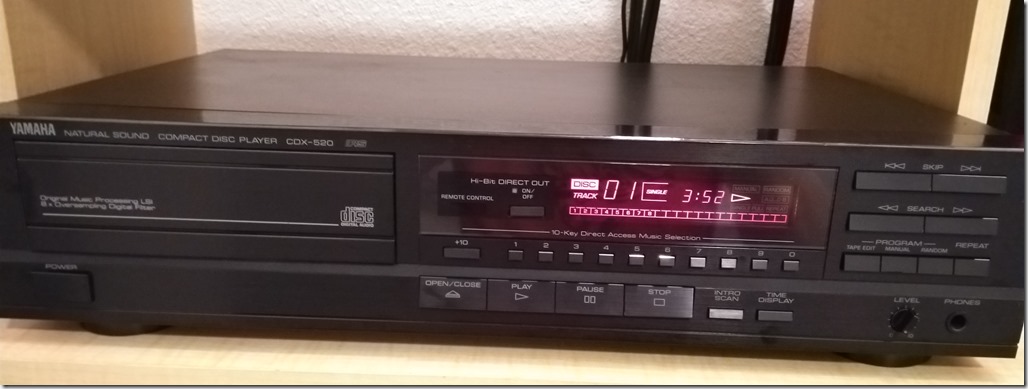
So I have, let’s see.  Let me count them… 8.  Eight CD players.  Since the last time I mentioned this, I’ve added a JVC XL-V141, which is a 90’s player, and yesterday, a Yamaha CDX-520 from 1989.  This is the Yamaha:

IMG_20210424_102515

My collection all meet certain criteria, partially for my promotional purposes if I get to the point of selling them.  All have physical power buttons (Off is OFF), all have headphone jacks, so the youngin’s can enjoy them without needing a full stereo.  Most have volume knobs for the headphones, which is a excellent touch.  You see, when things started getting cheaper, features got cut.  This is back when CD players were premium devices.  And yeah, these were about $300 when new.  Back in those dollars, which is probably $600 today.

So, I had purchased this neat new player for $25.  I was eager to try it out and clean it up when i got home.  Right away, I plugged it in and gave it a smoke test on a CD and headphones.  Tray opens and closes, that’s good, the disc TOC reads, good.  Ohhh..  It has a chronic skipping problem.  It just stutters all over the track like it’s on fast-forward.  Damn it.

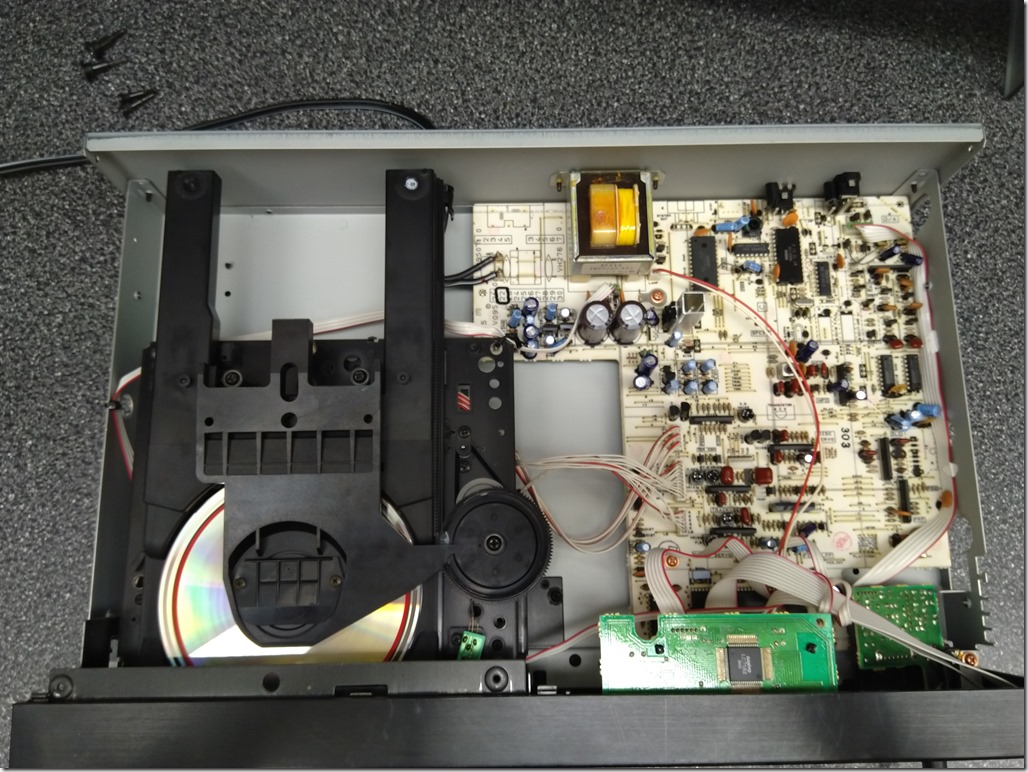
Pop the case off and look around.  I don’t really know what I’m looking for, just something out of place.  It all looks good.  I push a bunch of buttons and I notice that the CD doesn’t skip on later tracks, more on earlier tracks and chronically on the first track.  This is a clue, but I don’t know what it means yet.  This is pretty much what I had in front of me:

IMG_20210424_101235

While I’m reading my CD player repair document and looking over the player’s schematics from its service manual (which mean nothing to me), I go back and forth between the computer and the player.  Stopping and starting the player over and over.  Oddly, now it seems to be skipping less.  Then it’s not skipping on the first track anymore.  Is that all it was?  The player was tired and had been sitting too long, maybe just needed to warm back up?  What a crazy solution to the problem.

I tried a few more CDs.  Nope.  Skipping was still there.  So, I considered the problem wasn’t electronic, maybe mechanical.  Maybe the gears and rails for the laser transport needed cleaned and lubed.  I disassembled it and lubed up the moving parts with silicone lube on a swab (not recommended around electronics, but I’m stubborn).  Not any better, maybe worse.  Well, I’m going to have to level up on my repair skills.

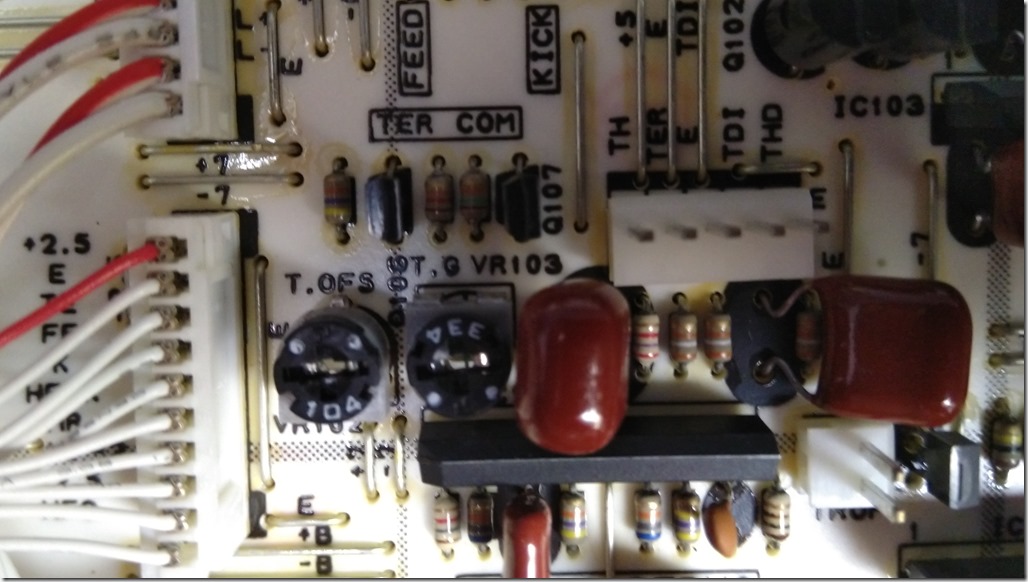
The repair manual discussed adjusting the lens tracking and focus using potentiometers on the circuit board.  The troubleshooting guide also said tracking issues would cause skipping.  Ok, let’s do this.  $25 already gone, right? 

I took a picture of the pots before I fiddled with them just to be absolutely sure.

IMG_20210423_174910

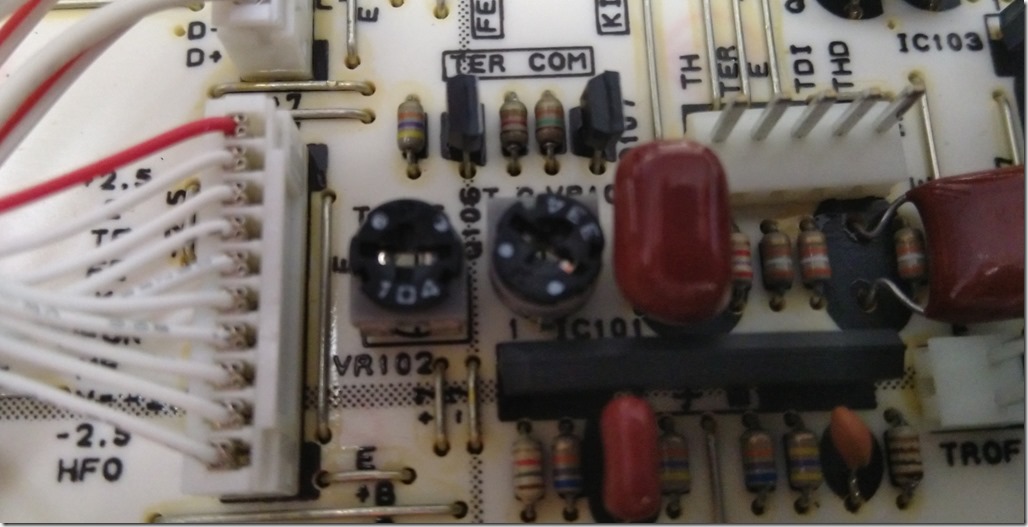
While a CD played, I slowly twisted the left pot and the skipping got worse.  Well, that’s a change in some direction, so I felt I was on the right track.  However, I couldn’t get things to get any better.  In fact, I experienced something the the guide warned about, with the CD spinning out of control at very high speed.  So, after powering the player down and resetting the pot to neutral, let’s try the other one.  In a couple small changes, suddenly the transport quieted down and didn’t seem to rattle anymore.  The skipping stopped!  This is the setting I ended up with:

IMG_20210424_101116

It’s not a major adjustment, but I imagine it’s not supposed to be.  I’ve been testing out the player on multiple CDs and no more skipping issue at all.

So, my little joke of a collecting problem has given me a new repair skill.  Formerly, my repair abilities were limited to changing belts, which honestly is pretty good and has brought a couple players back from the dead.  Now I have a new solution for a new problem under my belt.  I can fix even more players now.  A good hobby is one where you continually grow, right?

Decisions

As mentioned in previous posts, yes, I’m re-exploring music.  I have purchased and set up my recording PC and now I have to focus on the devices.  This had led me to a difficult decision.

I have a keyboard that has been with me for over 20 years – the Roland RD-600.  It’s been an excellent device and I am very familiar with playing it.  However, over the years the keyboard has worn out.  Some keys will break, or more specifically, the hammers on the keys will break.  I’ve dealt with this for many years, replacing hammers one by one as they break.  It’s an annoyance for sure.  I even have a small cache of spare hammers that I purchased from the manufacturer when this first became a problem.

And it’s still a problem.  On day two of having my rig set back up,  I broke a hammer.  I took the RD-600 off the stand, flipped the board over, and undid all the screws to open the case.  Replaced the hammer and flipped it back over to resecure the case.  Put it back on the stand and another hammer had broken during the repair of the first.  I give up.  I put the kb back in its road case and brought out the other keyboard.

Now this other board is an Alesis QS8.  I bought it at a thrift shop for $100.  It had issues right out of the gate with being out of tune.  I was loathe to throw it away though and figured now I could do some tests on it.  I determined that the MIDI functions still worked (that they were sending the right notes), which is what I primarily needed for recording.  I also found the setting where I could retune the device, and things were looking a lot better now.  However, further testing showed that the pitch problems would randomly reappear, requiring another manual retune.  And as far as the MIDI was concerned, there was some random data being spewed out from a wheel controller that I had previously physically disconnected.  So, this device is not suitable for recording either.

I have two bum devices.  My choices are, replace or repair.  Buying a new device of the caliber of the RD-600 or QS8 is a $1600-$2700 purchase.  Along with that purchase comes a new keyboard action, which I may hate.  Obviously there’s going to be more modern features and technology involved which is a distinct positive, if I wasn’t planning on using virtual instruments anyway.

I investigated replacing the hammers in the RD-600.  I can’t recall how much the initial batch cost way back then, but on eBay, each hammer is currently about $10 plus shipping.  It’s probably looking like about $1000 to replace all the hammers in my 20-yr old keyboard.  I contacted Roland directly to order the parts and they simply refused to sell any replacement parts to me and told me to take to an authorized repair center.  Bastards.

So now the question is, spend $1000 or $2000?  To complicate the matter, if I do refurbish the RD-600, I’ll never get that money back.  Street value of an RD-600 has to be well south of $500.  Hell, I only paid $650 for it twenty years ago.  I would spend more on refurbishment than I did when I bought it used.  But, this is a board I am intimately familiar with, and if it lasted 20 years once, it will last again until I’m long gone.  The alternative?  I can buy a new keyboard with new technology (maybe more durable, maybe not), may have better action, maybe not, may be a lot of things and may not.  If I don’t like it, I can sell it.  Sell it for what, 80% of its purchase price?  75%?  Less?  Will I lose more than I would pay for the RD-600 hammers?

And it’s shit like this that keeps me from going anywhere.  Weighing the pros and cons and never making a decision.

Oh, what about the other kb, the Alesis?  Well, I have an open inquiry to a repair shop to see what it will cost for repair.  I’m sure I’ll have to pay a bench fee, but that’s reasonable to know whether the kb should be repaired or checked.  The problem isn’t mechanical like the Roland, but it is electronic.  That could be better or worse.  But it won’t be $10 88 times over.

But I made a decision anyway.  The Roland is going to get refurbished.  I think it deserves a second life and I’ll be comfortable using it for recording.  My decision was made on a few different points.  First, Roland makes no mention of the RD-600 in their support pages, so I don’t think the hammers will be available for too much longer.  Second, I found an eBay seller selling one octave of hammers (7 white/5 black) for $120 with free shipping.  With 7.2 octaves in a piano, I would be pretty safe buying 7 of these, for a total of $840.  That’s not $1000 and it’s not $2000, and it’s not $2500, which is the price of the new keyboard I tried that had a hammer action I liked.

The seller was unwilling to discount his price for a purchase of seven octaves, because he knew what he had.  He knew the part was either discontinued or was soon going to be discontinued and told me as much.  I paid his price.  And I still will pursue repairing the Alesis, for the right price.  There’s a small part of me that wants to rebuild a whole studio with racks of 80’s and 90’s physical keyboards, but holy shit is that an expensive idea.  Obviously, a lot of those sounds are coming back into vogue with new music, so prices have been soaring.  Pawn shops used to be used device gold mines, but I can’t imagine any shop not doing their EBay research and finding out the value of what they have.  So virtual devices will still be the way, with a solid controller.

One More Time Before I Go

A little more information on something I hinted at in a previous post… I’m still quite reluctant to say much about it because I’ve done this time and time again with no success or completion.  Hopefully, without having any expectations, I can meet my expectations.  The "news" is that I have pulled my music gear out of storage and set it up again, with tentative plans to do some recording.

There were multiple reasons I came to this.  I had some inspiration listening to some albums and wanted to see if I could still compose.  I wanted to do some justice to older pieces by re-recording them properly.  My hands and fingers are getting old and weak and I thought maybe playing would return some strength to them.

The last recording I had done was in 2008, when I wrote a bunch of heavy guitar songs for an album.  My voice was unable to perform well enough to do the vocal tracks and the audio was marred with recording glitches like audio bleed from other tracks.  But, the point is, I haven’t done music in over a decade.  Obviously things have changed since then, but I will still be doing things the way I have always known.

Step one was to see if I could even still play anymore.  I pulled out the keyboards and set them up in my music room.  With some headphones plugged in, I tried playing some familiar songs.  To my surprise, the muscle memory was still there.  I remembered most of my old songs, with some stops and pauses to refigure out bits here and there.  The playing was sloppy as I expected and my stamina was greatly reduced, as I also expected.  I only spent about 30 minutes or so that first day to get familiar with the keys again.  The next day I spent another half hour or more with other songs and my stamina had jumped surprisingly just in that one day.  Now, here on day three, the joints in my left hand are sore AF, so maybe I overdid it.  But, the future is somewhat promising.

If I’m going to do this, I’ll need a new computer for recording.  The second computer I had laying around was converted into a web and email server a while ago, so I need to make another purchase.  Here’s the thing.  Technology has advanced SO far since I was last doing this (13 years!), I don’t need to buy a 4-figure computer.  I don’t even have to buy a full-size computer.  I bought a refurbished mini computer for $300 that exceeds the power of any computer back then.  And of course, I needed a new monitor and keyboard.  This time, what I am doing is buying a floor stand for the monitor and a bracket to mount the mini PC behind the monitor.  I’ll place the stand behind my keyboards or mixer and can move it as needed.  New technology is really cool.

Without any real goals or timelines, I’m going to relax and get familiar with the software again.  That has always been an issue with me – the process of recording gets in the way of recording.  There’s a universal image of artists working in a home studio, laying down tracks and fiddling with effects and editing and whatnot, but the notion to me of having an engineer handling and managing all the recording process where the musician can focus on actually playing and making music – that’s the real thing.  And sadly, the evisceration of the recording industry has made that concept a rarity.  Still, I am a one-person team, so I have to do what I can.  In the past, I have rushed all my projects because I have had to wear multiple hats and if I spend too much time wearing one, the others suffer.  In the end it all suffers.

So, It was 2000 when I did my last keyboard album, 2006 when I finished my last Sequence album, 2008 when I finished my hard rock guitar album, and I’ve been wanting to start the loop over again for a long time.  Looking back in the journal, it seems like I had recording aspirations in 2014, but I had other interests going on at the time.  It seems the only time I can really compose and record is when I’m single.  So, now’s the time!  Still, no promises.

Log On

Is there anything in the world that holds as much promise as a brand-new, unspoiled writing journal?  Conversely, is there anything sadder than a stack of journals with a few pages written in them, unable to be reused as much for their lack of virginity as for their obvious lack of positive energy, the evidence of their quality displayed (or rather not displayed) in the massive number of empty pages within.

I had a $5 free money coupon from Staples that I needed to spend (I never turn down free money), and initially I was going to buy some boxes so I could continue selling some of my excess CDs.  The Staples near my work didn’t have any boxes in the size I wanted, so I had some extra time to think.  During that thinking time, I had a idea for a log book and was unable to find any suitable journals in my house to accommodate the info.  Putting my idea and free money together, I purchased a new book today.  With coupon, it was essentially half-off.

And it’s a really nice journal.  I am really a sucker for clever journal designs.  I was initially considering a simple lined journal, where I would make dated entries in a linear format, nothing fancy.  But this journal had a neat calendar type design in the top margin to indicate the date, and well, that’s really all it took.  It also came with a plastic bookmark with stencils in it for drawing shapes, stored in its own pocket in the back cover.  Not only that, but the book also has ribbon bookmarks in the spine.  And not just one ribbon, but three – in two colors.  Talk about overachieving!

So I have this awesome new journal, full of potential.  What will be its duty?  Old-world scrobbling.  Scrobbling is a modern term for software that logs/records your music playing activity.  When you are listening to music in a non-networked fashion, as I do now, you use a log book.  I had once read online about people who keep a listening log book in their music room and faithfully record what they have listened to each day.  I found it interesting, but interesting for them, not for me.  Now at the time I had read these stories, I didn’t have a dedicated listening environment, not even really a stereo to speak of.  That might have been part of the missed connection. 

What brought me around to thinking I needed to do this?  There are a few reasons actually.

The first reason is that I have a lot of CDs, closing in on 2,000.  I don’t want to end up being one of those guys that listens to the same 10 albums all the time.  I need a reference log to see if I’ve listened to a particular album recently.

When I listen to an album, or when I want to relisten to an album, or when I want to choose an album, it would be helpful to have some listeners notes.  Descriptions of the sound quality, of things I noticed for the first time in the songs.  If I get a new version of a CD, does it sound better or different than my existing version?  That’s useful to me and to others that may want to hear something in particular.  I will have a reference of good or great sounding albums.

Another reason for having a log is the permanence of the log itself.  Sometimes I find that listening to music is almost a pointless activity.  It shouldn’t be.  Pointless is a bad choice of words.  It’s passive.  Don’t get me wrong, I do enjoy listening to music, but it’s like meditation, maybe?  You’re either in the zone or not and those two worlds don’t really intersect.  By keeping a log, it’s sort of reaffirming, "yes, this happened" or "this night was not wasted".  I don’t think I’m explaining this part well enough, but the point is, there is a record of an activity so that the enjoyment of the activity is not lost or forgotten.

I had planned on beginning the log at the beginning of 2021.  Like a new year’s resolution or something like it.  But resolutions are really a dumb idea.  The best time to begin a new task is today.  Right now.  If this log ends up on the top of my unfilled journals in two months, it won’t matter which month that final entry is made.

Stages Part 4.75

In the last installment in this series, I had added subwoofers to my stereo system and was thinking that there wouldn’t be a stage 5, which is the replacement of my small powered monitor speakers with large tower speakers.  In the six months I’ve been using this setup, I am still enamored with it, and have not felt the need to upgrade the speakers.  However, in the other part of the system, changes have happened, mostly out of fortunate opportunity.

The biggest purchase I’ve made in my stereo system is the subwoofers, by a massive margin.  Everything else has been had for well under $100 each.  Because second-hand stereo equipment can be found cheaply, it’s good fun to just try it out to experience the differences.  I had talked about this before with my small collection of CD players.  But one day at a thrift shop, I found a new receiver/amplifier.  It was made by Nakamichi, which is a brand you don’t see or hear about very often, because it is considered a high-end brand.  Checking the back of the amp, there were preamp outputs available, so it was immediately compatible with my system configuration.  The price was fine, $25, so it came home with me the same day.

Cleaning and testing was brief and successful.  The amp was clean and had no issues.  Sound-wise, it sounded a bit brighter than my Technics, which is consistent with other online reviews I read on the product.  Their words were more like "harsh" and "highly-detailed", which sounds a little negative, but as I’m learning with everything in audio, there is no truth, no absolute.  You just have to like what you have or replace it with something else you like better.  And two people can have two totally different opinions about the same thing.

So the Nakamichi has become my new default stereo.  The Technics amp and EQ have been moved to my secondary pile of equipment in another room.  And I have been enjoying my system.

Shortly after that purchase, I came across an online auction of a recording studio.  Among some of the items being sold were two "DVD players".  Researching the players a little more, I learned they are technically called "universal players", meaning they can play multiple formats.  While you can buy most any $30 DVD player and have it play CDs as well as DVD-Audio, the format of SACD (Super Audio Compact Disc), is much harder to come by.  SACD players are usually $1000+ unless you get into a universal player that also handles that format, in which case you’re in the $800 range.  Regardless, getting into SACD is not a cheap venture at all.

I actually do own a couple SACDs that I have never been able to listen to, as well as a DTS (yet another high-end format) disc.  These players in this auction would support all of these formats.  They were Pioneer Elite 47ai units.  Long story short, I placed absentee bids on both and won both, one at a low price and one at a high price.  After commission and all, they cost $75 each.  One will eventually be sold off, but the other has been integrated into my system.

Being in a professional recording studio, clearly the devices were well taken care of.  And upon some listening tests, I have to begrudgingly admit that things do sound better on higher-end equipment.  Granted, I am comparing 30-yr old consumer CD players to a 10-yr old professional player.  There should be some improvement, right?  And finally, being able to hear what SACD sounds like was a nice experience.  Was it amazing?  Well, no.  But – and this is an important but – I have made many small improvements to my stereo in a relatively short period of time, and each one has brought with it a positive change, no matter how small.  At no time have I done an upgrade and been disappointed.  Are things absolutely perfect?  Of course not.  I have CDs that will skip in one player, but not another.  So, I do keep two players on my stereo.

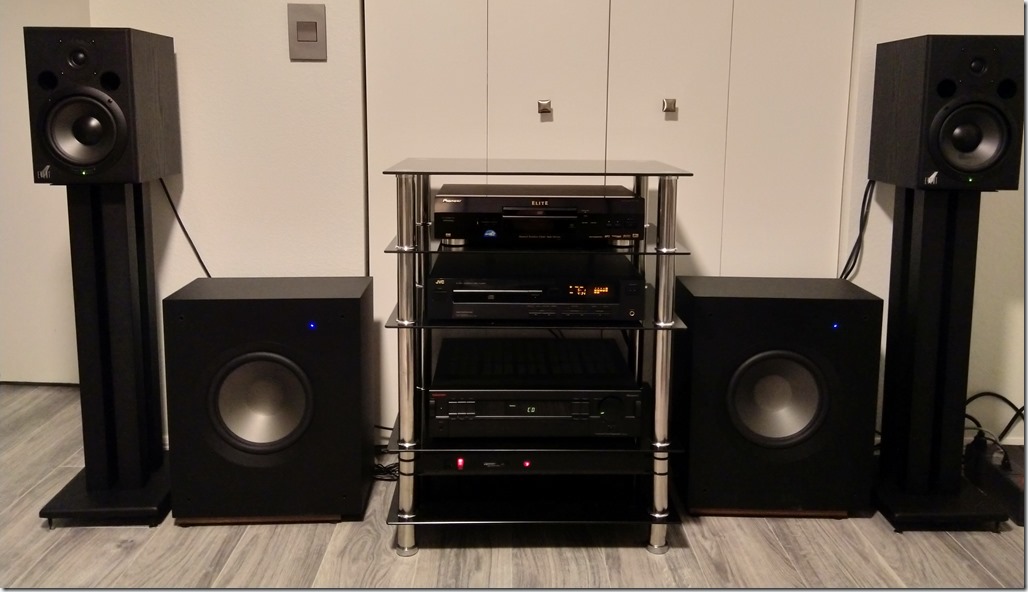
And that’s where my system is right now:  The Nakamichi amp, the JVC CD player, and the Pioneer Elite universal player.

IMG_20201130_195835

Stages Part 4.5

In previous posts on this subject, I’d been advancing my home stereo towards some goal of having big, energizing, musical sound.  The "final" step in the process was buying tower speakers for the amplifier.  I’ve come up with a step in between.

I was skeptical of the claims made that putting your bookshelf speakers on stands would improve their sound dramatically.  I was proven wrong.  The change was highly noticeable.  So much so, that it made me wonder if I really needed tower speakers.  At the very least, it would delay their purchase for a while.  The improvements got better when I separated the speakers from the stands with silicone buttons and added the floor spikes to the stands.  Both are things that audio fetishists go crazy over.  Not as much the spikes, but to read about the "isolation" and "decoupling" of the speaker from the stand using (only) sorbothane balls or brass spikes gets a little weary.

And I thought I had taken things about as far as I could with what I had.  One of the improvements I got with my changes was improved bass.  I could hear the bass and slightly feel it, too.  And you know, once you get a taste of something good, you want more.  That was going to be taken care of by the tower speakers, when I bought them.  But I wasn’t ready to buy them yet, because I liked what I had.  Well, I guess I wanted to like what I had more, so I had a choice to make.

That choice was whether to add a subwoofer to the system for the extra bass.  I read a lot of articles.  I researched a lot of products.  I reviewed my budget.  In the end, it felt like a "fuck it" decision anyway, so yeah.  Subwoofer it is.

Here’s the catch.  Based on what I’ve been reading, having a subwoofer is just not enough.  A very well-written article by a generally polarizing individual explained the technical reasons for subwoofer use in the 60’s, 70’s, then 80’s and beyond.  And that article, along with other higher-end articles stated pretty simply: you need multiple subwoofers.  At a minimum, you need stereo subs, because although it’s popular to say sub=bass is mono, it really isn’t.  But as long as you’re entertaining the idea of multiple subwoofers, having four is not out of the question.

Now, four subwoofers was not and would not be my plan.  But, while researching products, the subwoofer model that I settled on (due to price) did not have stereo inputs.  That would mean that I would have to buy a cable to merge the left and right channels to go into the sub.  I’m not a fan of that idea; it just seems wrong.  So the evidence is stacking up for getting two subwoofers.  The budget doubles.  So which one (or which two)?

You can get subwoofers with speaker sizes of 8", 10", 12", 15", or even 18".  I start small, looking at 8".  I need two of them.  The more I look at them, the less I am convinced.  My bookshelf speakers already have 6" drivers, and the tower speakers I was looking at for the future have multiple 6" drivers.  Is an 8" really going to provide the depth I should have?  So, I look at the 10".  That’s about as far as I will go.  There’s no way I can reasonable justify having two 12" or larger subs in my little listening room.  I wouldn’t even have room for them.  I’m already looking at compact subs because of space concerns.  But, if the future means I have a larger room for my listening hobby, then the 10" subs will be able to handle that growth.  If I do go with the tower speakers in stage 5, the subs will complement them as well.

So the retail price difference between 8 and 10-inch is $229 vs $344 – $115 dollars to upgrade to the larger sub with the bigger amp.  Because of sale prices, the prices are now $126 and $189 -  a bigger discount on the bigger sub.  Now, the upgrade cost is $63.  Still, I need two.  And after looking back and forth and back and forth at numbers in both my web browser and in MS Money, I reached the "fuck it" point and bought two 10" subwoofers.

Fortunately, the subs do come with cables, but I did need to buy two splitter cables, to send the low-level output from my pre-amp to both my bookshelf speakers and the subs.  And what have I ended up with?

IMG_20200618_172520

Also new in this picture is a switched power strip mounted below the amplifier, which turns all four speakers on and off.  Since all the controls for the subs are on the bottom of the units, and I was getting concerned and also annoyed by pushing the power buttons on the speakers each day, a single switch should help everything.

Now, how does it sound?  I started my test with all knobs set to the minimum and put on Rush – Signals as my first test.  I went through a few tweaks, raising the crossover, raising the input level, lowering the crossover, and back and forth between the different possibilities.  The result was nice, but not earth-shattering, nor room-shaking.  I was underwhelmed.

Then I thought maybe my choice of album wasn’t that great, so I put on Edgar Meyer – Dreams Of Flight.  Holy shit.  Now I was shaking the walls, which was actually hilarious to see the cat repeatedly alerting on the sound of the pictures vibrating on the wall.  With that album, I did a few more tweaks and lowered the levels a little.

The next test was Tom Petty – Full Moon Fever.  Being produced by Jeff Lynne, certainly this album would have a lot of things happening everywhere in it.  And I wasn’t disappointed at all from the results.  My expectations were being tempered by reality.  Where I expected kick drums to hit me in the chest, that’s not how (decent) albums are mixed.  But what I wasn’t expecting was the loss of the shrillness.  When I would turn up the stereo before, I sort of had to grit my teeth and suffer the high end to get any power.  With the subs hooked up, It was like the high end was tamed.  I don’t want to say "lost", because I don’t think it sounded any duller, just less piercing.

The last test was Iron Maiden – Seventh Son Of A Seventh Son.  I didn’t get the sound I expected, but the sound I got was excellent and very engaging.  My ears weren’t ringing at the end either, which was a blessing.  And it seemed like I was able to go louder than before, probably because I wasn’t getting ice picks in the eardrums.

I’m actually thinking there may not be a stage 5 now…

Stages Part 4

In the previous post on this topic, I discussed the stereo buildup to the point where I had a good listening system.  The next transitional step would be to physically prepare it for the tower speakers, which will be stage 5.  I had made another post about the fortunate timing of my speaker stand purchase, which saved me around $50 or almost a third of what I had budgeted.  So the items have come in and are ready for implementation.

The first piece that came in was the stereo rack.  All black glass and chrome, it allowed each component a shelf of its own, but I still kept the amplifier and equalizer together.  Quality-wise, the stand is a big meh.  I didn’t pay a lot for it, so I can’t be disappointed, but I expect at some point, I’m going to be getting a better rack.

The next day, the speaker stands come in.  Heavy steel plates and posts, which are supposedly the key to keeping bass and separation.  No disappointment here.  We’ll have to see how they perform.

I disassembled my setup and moved the current table out of the way for the new pieces.  While behind the system, I did a little wire management for tidiness sake.  This is what it looked like.

IMG_20200522_174457

What did it sound like?  Well, I don’t want to get into all the audio snobbery adjectives, but I will say it sounded better.  Significantly better.  Of course, maybe it’s a placebo effect, I’m not going to rule that out, but I tested out two different CDs, with widely differing musical styles and both sounded more impressive to me than I remembered before.  So I will call it a success.

What’s stage 5 again?  Tower speakers.  Well, that can wait for some time now.  I’m going to have to get tired of this new sound, which could be a little while.

Collection Completion And Expansion

I want to start off by mentioning that CDs are collectables.  There is one irrefutable reason I can make this claim.  That reason is the irrationality of the pricing of any particular CD.  While it shouldn’t be a surprise that any particular thing can be collectable and priced unreasonably high when it becomes scarce, sometimes, the outrageous prices set a particular expectation when researching and shopping.  In this way, I suspect there are a lot of dealers of collectables who will list items at outrageous prices to get people’s expectations set, then actually sell an item (maybe even as a different vendor) at a price less than that expectation, while still being somewhat unreasonable.

So anyway, this is about the last CD in a series that I need for absolute completion.  I’ve been satisfied with what I’ve had so far because those that I have are all of the retail versions out there.  The one I have been missing is a promo-only copy.  Not only a promo-only copy, which could include retail copies with a "Promo, not for resale" sticker or stamp on it, this is a promo-only version.  Obviously far less available and made in much lower quantity.  All this time, there has been one seller of this disc, offering it for $50 plus shipping.  The guy knows the scarcity.

Very recently, a new seller popped up, selling it for $30.  This guy knows, too.  And he’s looking to make a sale based on the one and only one person who has this CD in his wantlist (me).  And you know what, he almost had me.  I was getting ready to buy it when I decided to do a quick sanity check on eBay.  eBay has never had that CD before, but you never know.  And amazingly, it’s on there now.  And only $10.  It’s an immediate buy for me.  Sure, I just paid a decent amount for a used CD, but it’s been unavailable for years and has had an unflinching price of $50.  And now, my collection is absolutely complete.

Do I have other discs in my collection like that?  Yes I do.  Will I be fortunate enough to reap the benefits of scarcity when I sell?  Collectors don’t sell.  That was a trick question.

So, like I said, that completes the collection.  The IRS NoSpeak series is now complete.  The original CD collection that got me into being a completist was the MCA Master Series, which I’ve posted about many times.  Out of curiosity, I did a search to see how much of that series was available for sale on eBay right then.  That would give me an idea of the scarcity of my collection.

I would say it was maybe 50% available and of those, many were double-digit prices, so that’s actually pretty promising, from a value perspective.  But as I was browsing the results, I didn’t have any category filters set, so I was seeing CDs, cassettes, and vinyl.  But there was another product that was in the results – a promotional poster from the record label for the MCA Master Series. 

Well, now.  There’s a product you don’t see very often.  In fact, I’ve never seen one ever, nor heard of it existing.  And that would be understandable.  Posters are given to record stores and other record label contacts, are hung up until they fade or rip (or the label goes out of business), and are discarded.  No one keeps promo material like that.  But here was a surviving example.

I’ve posted before about my big artwork project of scanning, printing, framing, and hanging all of the MCA Master Series album covers as art in my house.  There should not be any doubt whatsoever that this poster must belong to my collection.  And so it became.  I don’t buy a lot of posters.  I don’t really know how much they go for.  But I got this poster for $16 shipped.  Considering the thing is over 30 years old… I don’t think that’s too bad.  It’s a decent size, also:  28" x 26".  I have a place picked out and expect I’m going to spend the big $$$ on a professional framing job.  Once stores open again, of course.

In all, this has been a spendy weekend.  But, a lot of stuff is changing in my music room.  Now stands for stereo speakers and components, a few new CDs are on the way, and a neat poster to hang in there.

A Long Time To Decide

The quarantine finally got to me a couple of days ago and I had to go out for a drive to get some dinner at a place about 90 minutes away.  On that drive, I had a CD by The Good Rats and a song came on, Victory In Space.  This song is somewhat about NASA buying hookers for astronauts, but it’s also the germ of an idea I had for a NaNoWriMo novel.  The story idea – all I had – was about an intergalactic hooker in an erotic comedy genre.  That’s open to just about anything I could think up.  So when I heard that song come on, it got me thinking about the story again.

NaNoWriMo is still 6 months away, so I have plenty of time to commit and begin planning, or just let the idea waste away for another year.  Last night as I was falling asleep, I gave some consideration to the idea.  NaNo doesn’t care what format you write in, as long at it has a word count.  So I started thinking out of the box.  First I considered something like a series of blog entries.  There’s lots of ways I could present that.  First person, like a journal of the hooker; or third person, writing about her.  But blog entries always have this "newer is first" problem that makes reading a story difficult.

While thinking about the navigation aspect of such a story, it led me in a different direction.  Maybe I could write a choose-your-own-adventure story.  Hypertext and links are the perfect medium for presenting a story like that.  However,  a story like that could be a massive undertaking and while it’s literally unlimited in scope and plot, that’s also its downfall as many paths would be unfulfilling.

Considering those issues rekindled yet another memory of mine, where I would imagine I was a movie director.  My magnum opus would be one movie with at least 4 different plot lines in it and each had different endings based on the result of a climax in the second half.  The first half would reuse most of the scenes in each of the plots, but there would be some differences between them, like being shot from a different perspective or in a different place at the same time, showing extra info about the other potential plots.  The goal of the movie would be to cause a bunch of confusion at release time with different reviewers writing about the story and their reviews all conflict with each other as to what happened.

With that in mind, what if I did something similar with my adventure story where as you progress, you might end up in a different plotline depending on when you navigated to the next page?  But who would ever notice something like that?  You’d have to make it known at the beginning to watch out for it, which would just spoil the whole concept.

And all this is just thinking right now.  I’m not even sure I want to commit to another month of writing non-stop.  And if I did, it would be a planned story instead of my usual figure-it-out-as-you-fuck-it-all-up style. So that could slow me down anyway.  We’ll see…