Tag Archives: Finance - Page 6

The Quickening II

Like a bad sequel, I get to continue a story that should have ended.  As I discover some things in Quicken I don’t like, I check the opinions of blogs and Quicken’s own support forums and I am saddened by what I learn.  I guess none of my gripes are new, but they are mine.

I’m sure I’m going to have lots of fun matching transactions as time goes on.  I’m convincing myself that the real numbers matter starting next month – a fresh month of a fresh year.  But right now things are off.  One of my accounts had to have an adjustment posted to make it match with the last bank statement.  That worries me.  As I cleaned up the categories for my transactions, I found that when I would categorize a transaction as a transfer, it would helpfully create the other side of the transfer for me, duplicating a previously-downloaded transaction in another account.  So with all the credit card payments I categorized, I suddenly had a massively negative balance in my checking account.  More cleanup…

As I worked through these various screens I found myself missing a Microsoft standard: the Back button.  I remember years ago when I tried out the Zune at Staples, I thought to myself, “MS loves the Back button.”  The Zune has one.  And you know, it is the easiest concept for anyone to understand.  I also was a little weirded out at how some screens are windows of their own and some are in the main window.

And continuing with UI issues, I found the little things to be the most annoying.  Like being unable to resize columns.  The text in a column is truncated, but you can’t expand the column to see it.  You have to mouse over each row to see the tooltip.  I’m slowly getting used to Quicken’s way of doing subcategories – using a colon.  Money had that format as an option, but I turned it off.  The UI, overall, is definitely from another line of thinking – and not very much in line with Microsoft’s design recommendations.  I’ve had the argument before about how being consistent with Microsoft design helps a user understand your application quicker.  The additional time it is taking me to understand how Quicken works is a fine example of this.  Holy crap, I just discovered that some (4) popup windows I thought had closed actually didn’t.  They’re in a pseudo-taskbar at the bottom of the main window.  Good god.

Now the bigger issues.  The biggest being that the filtered view in the register does not maintain the proper running balance.  It shows a running balance of the transactions shown.  This makes the filtered view useless, but Quicken users have been living with it since the feature was introduced.  That’s nearly a deal-breaker, but I’m going to stick it out.  The other big one is there is no transaction entry form (that I can find).  You have to enter all your info directly in the register.  This brought back a very distant memory of when I first used Quicken and I didn’t like that method of entry.  Money provided a more presentable form for entry and it was a significant selling point.  Money also allowed the option to enter transactions Quicken-style.  Funny how Money tried to implement a more Quicken-esqe experience and ended up being the one that failed.

I feel a bit sad that Quicken is now the only major player in this software category.  Mostly because I know they can never make the changes needed to satisfy the MS Money crowd without ruining the experience of legacy Quicken users.
The Quickening

So I’m at the 7th and final stage of grieving: acceptance.  I have accepted that Microsoft Money is gone and will not be coming back, so I must move to Quicken.  It’s not without trepidation that I purchase Quicken and try to recapture the enjoyment of tracking my finances with a new program.  I had used Quicken a long time ago and was not as pleased as I was with MS Money, which is probably why I’ve used Money for over 10 years.

So I’ve gotten Quicken Deluxe 2010 installed and the first thing that pisses me off is that it has put icons on my desktop.  Not just one icon, which is tolerable, but 4.  One for the application and three sales pitches.  This is a terrible first impression.  One shortcut is to a co-branded version of FreeCreditReport dot COM – one of the biggest scams out there.  One is for their BillPay service, at $10/mo.  Even Wachovia, a premier bank, only charges $6/mo for integrated BillPay.  Unless Quicken doesn’t have 2-way integration with Wachovia, which is practically a dealbreaker for me.  MS Money had it. (Turns out, yes, Quicken does support online payments through Wachovia)  The final offer is for a typical rewards credit card provided by Chase.

First Launch: I am prompted to “Get Started”.  I have to enter my banks and their login info so Quicken can download transactions and whatnot.  I’m mildly impressed.  In MS Money, this was a separate step after setting up accounts.  It picks up my Wachovia account without a problem.  Then I do my Chase account.  Oops, there was a problem.  It says to try again later.  So I think, “Maybe it should be entered as a WaMu account, since that’s where it was originally opened.”  Nope.  Not found there.  It’s later now, so I try again under Chase.  Quicken crashes.  Ok, my impression of this program is sinking fast.

Second Launch: I get all of my accounts set up.  And I am quite impressed with how well it handled ALL of my accounts.  If I had a login for it, Quicken handled it.  I got my loans entered and the wizard was pretty easy to work through.  I browse through the preferences and set a few things to my liking, like two-line registers.  Now, I am downloading transactions for an account that doesn’t have real-time transaction updates.  And it’s frozen.  However, I was able to close the window (X) and it seemed to be a successful update.  We’ll see how that turns out on the others… ok, three of the four I had to close the window, but they seem current.  Not sure of this is going to be an annoyance or it’s just a fluke.

I’m going to give it an honest try, since I have no other choice, really.  I’ve tried GnuCash and that was definitely a step down.  So we’ll see how quick things get.

The “have it” habit

At dinner tonight, I had the opportunity to train a new employee.  Not directly, but because nothing I ever do is simple, they got to experience exceptions to the order-taking routine.  At the close of the transaction, I was going to say something to the effect of “Enjoy your employment, lucky person” but decided against it.

As I ate, I considered this a little further.  I’m (still) employed.  I’m doing ok.  But at the same time, I’m a responsible employee and a quick learner.  I could have that job!  And since I’m still employed, I’m more desirable to employers because it shows I can keep a job.  I should have that job.

But what kind of flack would I take for doing something like that?  I’d be taking jobs away from someone who really needs one.  “You already have a good job.  Stop hoarding the jobs, jerk.”  This transitioned my thinking into class warfare: the “have’s” and the “have not’s”.  I think this needs revision.  It’s the “have not’s”, the “have enough’s” and the “have more’s”.  See, I want to advance from “have enough” to “have more”.  And I could, because I’m not currently in the “have not” crowd.

But like I said, that’s not really fair.  The rich get richer, as they derisively say.  I would be suppressing the “have not’s” – the class below me – from advancing to the “have enough’s”.  So, in order to spread some of the wealth, I will take that job.  And another.  And maybe another.  Then I will outsource my jobs to another person who could not get the job on their own.  Wait, it’s not really outsourcing, is it.  Insourcing?  No, not that either.  No, it’s reverse subletting.  I am going to sublet my jobs at a lower wage and take the difference as a “convenience fee”.  It works for property, why not jobs?

But as usual, I’m so far behind the times.  Of course, this is already done with day laborers, contract positions, and other temporary positions.  But those are all handled by businesses.  Businesses run by rich people.  The “have more’s”. Once again, I’m getting held back by the man.  It’s so hard to get ahead anymore.  Woe is me.

Financial Voyeur

I am developing a strange addiction to watching financial news.  It’s sadly like other people’s obsession with celebrities.  I say that because financial news is generally crap.

It just seems that the headlines take the current headline and use that to explain the days movement of the market.  Like yesterday it was "Oil rises above $40 on Mideast tensions" and today it’s "Oil drops below $40 over world economic concerns".   I don’t think they have any clue.

I know it’s unhealthy to watch the markets daily, but like a voyeur, I never take action on what I see, it’s just filler, junk, vapid nonsense.

So anyway, that’s my confession.

The American Dream

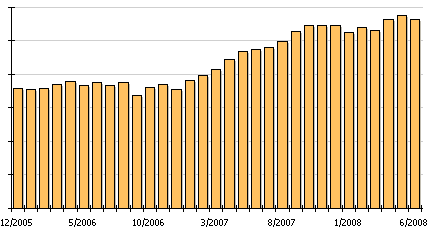
Part of The American Dream is supposed to be owning your own home.  I am a homeowner and was a long-time renter.  Recently, I noticed a chart in MS Money that made me take notice.  It was the "Net Worth Over Time" chart.

NetWorth

Can you tell when I became a homeowner?  It was February 2007.  The beginning of a steady climb in my net worth.  Prior to this, I was a renter, and the chart shows, my net worth growth was pretty stagnant.  Sure it went up as I put more in my retirement accounts and paid down debt, but not like the climb after becoming a homeowner.

Some argue that the expenses of owning a home outweigh the benefits, since rent covers all housing expenses.  As the chart shows, even with the expenses of a house, the value still grows.  This is equity.  When you buy a house, you have a property worth $x.xx, but you have a loan worth $x.xx, too.  It’s net zero.  Current housing conditions aside, as you pay down the loan, one side of the equation goes down, and one remains constant.  Whereas when you rent, you have property of $0.00 and a loan of $0.00.  As you pay your rent, neither side changes (for you.  It does for the rental property owner). You remain at zero.

I just thought I’d make a small post to say that this small visual reminder showed the value of home ownership to me.