Category Archives: About Me

Explosive Inflation

Yeah, I’ve heard it and seen it.  But this one really takes the cake.  Not so long ago, I was buying more cables for my studio, because you never have enough, and I had put off my purchase by a couple of weeks, which resulted in the total price going up $4.  not a lot, but still that was the loss of one cable that I could have gotten for the same price.  One month down the road and I need more cables, because you never have enough.  Those same $4 cables I was buying are now $10.  Ten fucking dollars! For what used to be $4 only a month ago.  So, this leads me to a place where people go in hard times – making it on your own.

Before I had gotten the sticker shock of buying the new cables, this was something I had briefly considered – that is, making my own cables.  That particular moment was when I had run out of short cables and I was using big 10ft cables where I only needed a 3ft cable, and I was thinking maybe I should just cut the cable shorter and put a new end on it.  I have the tools and skills for soldering now that I didn’t have previously, it’s not impossible.  The only thing I was missing was the jacks. 

And now with 3ft cables costing $10, the research began in earnest to see if I could make a cable cheaper.  And it seems I could.

Since all my studio patchbays are TRS (stereo jack) and every device connects to a patchbay, all my cables have to be a single 1/4" TRS to two 1/4" TS (mono jack).  These are typically sold as "insert cables", which are used for insert jacks on a mixer, where one TS jack is the output and the other is the return input, but yeah, they can also be stereo splitters, sure.  And that’s how I use them.  So I priced out the bulk parts that I would need: cable, jacks, and Y boots.

I can buy 100ft of stereo cable for about $.50/ft.  TS jacks are about $1/ea in bulk, TRS jacks are about $1.20/ea, and surprisingly, the most expensive part is the Y boot, which are about $2/ea.  If I want to be less pretty about it, I can just use heat shrink tubing which is probably under $1/ft.

So, roughly, a 3ft insert cable is 3ft of cable, two TS jacks, one TRS jack, and maybe a foot of shrink tubing.  That’s about $5.  So, a month ago, it wasn’t worth it for me to entertain the idea of cable-making.  Now it is.  And the benefit of having custom-length cables instead of 10ft of spaghetti wrapped up in my racks is a nice bonus.  And, it’s another hobby.  Why shouldn’t I try something new, especially when it involves saving money by spending money?

Talking Your Way Out Of It

I’m stopped on the side of the highway, hazard lights on, windows down, hands on the wheel, sunglasses off – waiting.  The highway trooper walks up from behind the car toward my window.  Hopefully he sees the effort I have gone through to ensure he doesn’t feel threatened.

The trooper looks in at me.  "I stopped you for speeding.  Do you know how fast you were going?"

It’s pretty common practice to feign ignorance to this question, but I’m a terrible liar.  "I know exactly how fast I was going."  I point to my dashboard where the cruise control has my saved speed conveniently displayed. 

The trooper acknowledges and since I’ve already incriminated myself, decides to see just how much I’m willing to give up.  "And do you know the speed limit for this highway?"

I point to my car’s infotainment screen, where Android Auto is running. "Google maps shows the posted speed limit right in the corner."

I can tell my honestly is throwing the trooper off. "You understand there are laws against exceeding the posted speed limit, correct?"

"Of course, officer.  But I do have opinions on that, if I may share them."

"Opinions on law are generally reserved for Supreme Court Justices. Are you a judge?"

"I am neither a judge, jury, nor executioner, but I would still like to have a say."

The trooper rolled his eyes.  I couldn’t see it because of his mirrored sunglasses, but your head always makes a telltale motion when you roll your eyes – I’m very familiar with it.  I’d already piqued his curiosity with honesty, he was now invested and I knew it.  "Go ahead then," he impatiently replied.

"You see, officer, laws don’t just appear out of nowhere.  They are always in response to a prior incident, as a deterrent for having that incident happen again.  They are created for the benefit of society, so that individuals can’t behave in a way that negatively affects society as a whole."  The trooper remained stoic.  I continued:  "At the same time, a law is inflexible.  It’s a boolean.  You are either within the law or not.  I recognize that flexibility can be introduced through the choice to enforce the law or not, but that’s not what I’m arguing for here.  This is a much bigger concept."

The trooper looked back down the road, maybe for his own safety, to see if there were any cars coming, or maybe simply wishing for an escape from this person climbing a soapbox.

"I’m honestly not against traffic enforcement.  In fact, I would like to see an increased amount of enforcement.  However, my targets are different.  And this is because speed itself, within reason, is not unsafe.  What is unsafe, is deviation.  If everyone is going 85 miles an hour, the speed limit is effectively 85 miles an hour, regardless of signage.  And conversely, if weather is bad, and everyone finds that 60 miles an hour is better for conditions, that is the speed limit.  And in both cases, someone who is driving 10-15 miles faster, or slower, than the pack is a moving hazard.  These are the deviants.  These are the ones that need enforcement."  I pause to let my point sink in.  I can’t tell if it is or not, since I am getting a blank stare.

"It’s kind of funny, officer, highway driving is almost a microcosm of society as a whole.  What’s good for the group is good for all.  Individualism is a bad thing.  But, we don’t feel that way here in America, do we?  And of course, you have those people out there, doing whatever they want to do, disregarding the safety and well-being of anyone else but themselves.  It’s their right, you know?  And those rights will not be infringed, right?  Well, we do have laws, but like I suggested earlier, they can be selectively enforced."

"And to a certain degree, I can see their point.  There’s a lot more people nowadays than in decades past.  The roads are much more crowded now, which means that now, more than ever, we need to work together so we all survive.  Sometimes you need to sacrifice for the benefit of all.  Ha, it’s that socialism stuff again!  On or off the road, some people just don’t want to be around other people, don’t want to sacrifice anything.  Hmm.  I wonder if that’s why they have an obsession with boats, so they can go somewhere uncrowded and don’t have to follow any laws.  But oh yeah, did you ever see pictures of the time there was a boat rally and everyone just behaved how they wanted and did whatever they wanted and boats got swamped?  They can’t even get out of their own way, haha."

"So, to go ahead and get to the point – the part you can actually do something with – I want to see traffic enforcement using drones to identify the individuals that are speeding through or holding back the pack.  Get those people and get them in line.  By definition, there can’t be a lot of them, because if there are a lot of them, they’re the pack.  Does that make reasonable sense?"

The officer sighed.  I couldn’t hear it because of the wind, but your body makes a telltale motion when you sigh.  I am familiar with it.  "Sir, you’re the only one on this road and you were exceeding the speed limit."

"Exactly.  I am the pack."

The officer did not reply.  He thought for a moment and straightened himself up. "I’m not going to ticket you today.  I have your entire statement recorded on my bodycam for the record."  I nodded slightly.  "What I am going to do is post this on our social media site.  I’m not sure yet if I’m going to edit it to make you look like you’re a genius or you’re insane, but either way, it’s going to get a lot of views.  You shouldn’t have taken your sunglasses off.  Have a nice day and drive safely."  And with that, he walked back to his car.
Searching For Gold

I had an unusual experience this weekend.  I was browsing the Internet and was seeing posts about this racoon girl getting gold in skating.  She had a visual style and attitude that was impossible to ignore so I got sucked in reading the post comments.  Gushing praise about how you could tell she just loves what she was doing.  Stories about how she quit because it wasn’t fun and started again just for fun and not for competition.  And more and more comments about how you could see it in her routine.

I’m not a sports person, and figure skating is even further down the list than other accessible sports.  It always seems clinical and kind of robotic to me.  Regardless, I watched the clip that won her the gold.  I guess it really was evident.  Maybe I was prepped by all the comments, but it did strike me differently than other skating displays.  And then the two pieces came together for me – she’s doing it because she enjoys it.

Now to make it all about me.  Wait a minute, is this guy going to compare himself to an Olympic gold medalist?  Hold on now.  It’s not like that.

I’ve been slowly working on a new album of music in-between my constant acquisition of new gear.  It’s been harder this time around for a couple of reasons.  I’ve had long-standing doubts about my writing.  I could easily build up a list of criticisms:  Too many major chords, always the same 1/4/5 chord progression, same old 8th note rhythm, it’s the same song over and over.  So I’d been struggling trying to do something different.  The recent piece I had worked on that tried to be different with darker voicing and stranger key changes made me sad.  Was this going to be some slow, boring morose album?  I didn’t want that.

But after watching that skate routine and reading comments and full opinion articles about how her outlook and attitude is a lesson on how to approach difficult situations, I sat down and knocked out two of the most joyous tunes I’ve done in a very long time.  It was a similar feeling to when I completed the first track on my previous album and declared that it was going to be a great year.

The songs?  1000% in my tried and true style.  And the important thing is, so what?  It’s what I do.  And I’m not doing it for someone else.  I’m not saying I’m a gold medal player or writer.  Lots of people can and do do it better than me.  But what I’m saying is, I am the best at doing what is my signature style and it might be difficult for others to duplicate.  Sure, they could with effort, but I just did it effortlessly.  And the final product is that I am fulfilled listening to them.

There will be opportunities to experiment and try other styles and stretch my abilities, but what I had been doing was shutting off my natural style in order to do something different.  it’s like, I need to run fast, but my legs go slow, so I should remove my legs because they only go slow – obviously that’s where the problem is.

This Isn’t Even My Final Form!!

Picture a Saiyan warrior, standing alone, screaming his head off, trying to raise himself to the next level of power.  Such is my experience with my home studio.  It’s been about 3 years now since I first began acquiring gear, initially to remaster some old tracks, then to create new tracks in a more traditional, non-in-the-box fashion.  And there seems to be no limit to the amount of gear that is available due to aging, the abundance of new gear, and more people’s choice to go in-the-box for music creation.  So, my choices have been plentiful and I’ve taken advantage of that.

It’s a little reminiscent of when I started collecting CD players from thrift shops.  It was something I never could have entertained in the past, having the ability to experience different players and notice their sonic differences – something reserved for audio reviewers and people with tons of cash.  But now, I can experience all these different synths that I never would have been able to before.  So it’s a golden era for experimentation.

But growth comes with challenges as I’m sure any Saiyan warrior would know.  Like where do you put all this muscle?  I am literally out of room in my bedroom studio.  I just completed assembling my third rack unit and I don’t have anywhere to put it.  It’s just kind of in the middle of the room.  But it’s on wheels, so it can go wherever.  And this brings me to the next evolution in the studio.

Discovering patchbays and their functionality was a total gamechanger for me.  Once you come to terms with the cost and quantity of cabling you need to purchase up front, everything becomes easier from then on out.  My current bottleneck is that I have a rack that is physically tied to my mixer and my keyboard stands via MIDI and audio connections.  The goal is to make racks "Red" and "Deep Wood" uncoupled from everything.  Rack "Grey"  (formerly "Blue"), which contains effects and guitar processors, has always been uncoupled and it’s been an excellent model for where I want to go.  So how to accomplish this?  More patchbays!!  And another "rack".

The end goal is to tether the keyboard stands to a new patchbay located at the main mixer.  Each set of stands will have their own MIDI interfaces, coincidentally the same make and model – 2x Edirol UM-3x units giving 6 ports to each stand.  Then the rack at the mixer will contain that patchbay and the audio interface.  I also plan to relocate the recording PC onto a shelf in the rack.  So that’s one "unit": the mixer, the patchbay connected to the keyboard stands, and the audio interface connected to the PC and the mixer.  In a world with no racks, that would a complete setup.

Racks Red and Deep Wood will be identical in design.  Each will have a patchbay, an 8 channel mixer, and a MIDI interface.  The audio from the devices in the rack go to the patchbay, which map, normalized, to the 8 channel mixer.  Devices in excess of the 8 channel capacity can be patched into any channel as needed, which is how a patchbay is to be used.  The output of the mixer goes to the local patchbay, which then routes to the patchbay at the main mixer.  The MIDI interface in the rack connects to the PC.  This setup means I can easily play up to 8 devices from each rack at a time, and that’s not a hard limit.  I can patch more devices from any rack over to the main patchbay as long as I’m willing to handle cables being strewn about.  I can patch Rack Grey in anywhere, even directly to the main mixer.  Complete flexibility.

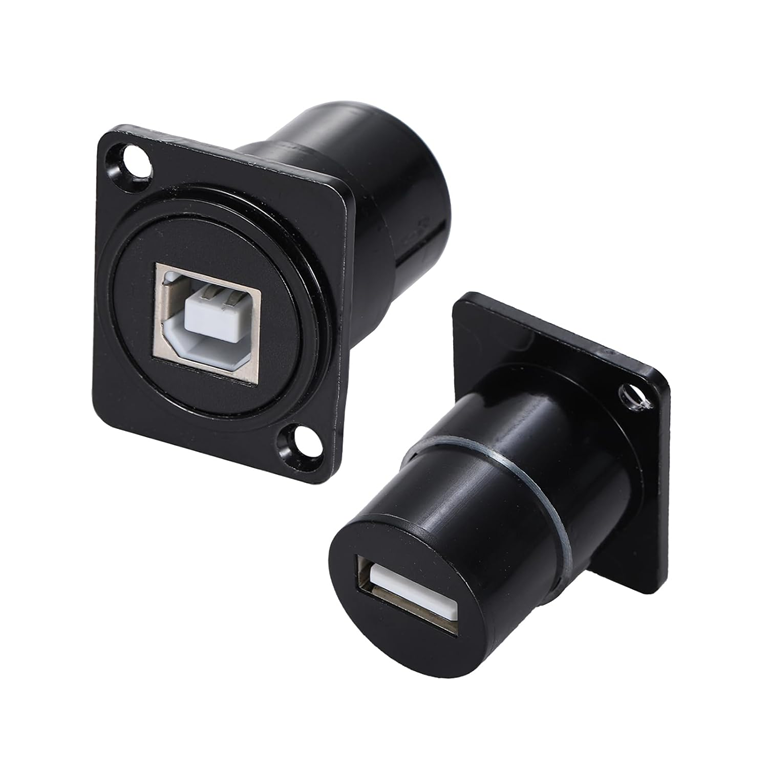
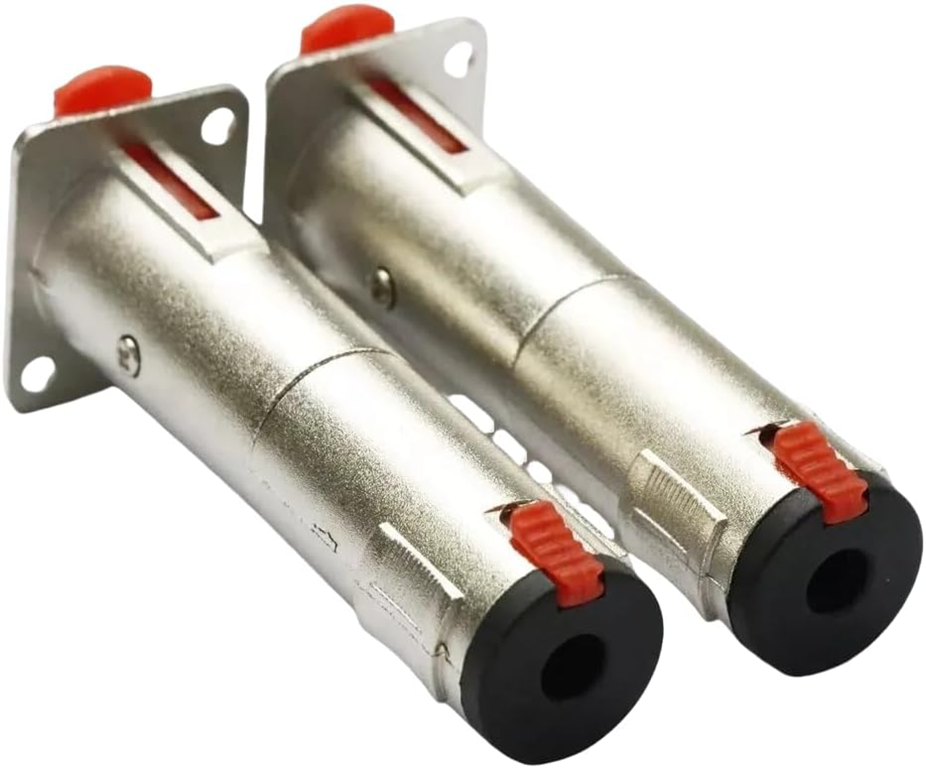
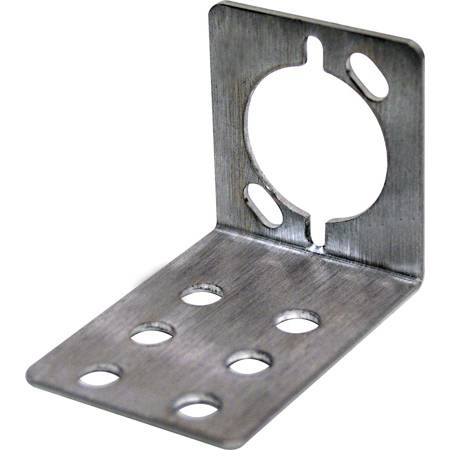
But I did say "uncoupled", didn’t I?  Having a USB cable and a TRS cable tying each rack to the main patchbay is hardly uncoupled, right?  And that’s where the most clever part comes in.  Each rack will have jacks mounted at the back to quickly connect or disconnect them so they can be rolled in or out or where they may need to be placed.  This is done with these pieces:

 image image image

I mount the TRS and USB Neutrik jacks into the brackets and mount the brackets on the side of the rack.  The jacks connect to the internal patchbay and MIDI interface.  Then I have quick-disconnect jacks.  Elegant.  This little detail excites me the most about the new setup.

The parts are slowly coming in.  The last bits that I’ll need to do is fabricate the new rack to sit underneath my mixer that will hold the audio interface, patchbay, and shelf for the PC.  The 8ch mixer for Rack Deep Wood is on backorder, which is probably just as well, since I’ve been spending money like an American.  As far as the latest rack goes, I have about 7U of space left in it.  God forbid I fill that up and have to bring Rack Blue out of retirement.

You Get One Chance And You Have No Idea If You’re Doing it Right

Today on my drive to spend $75 on a device (which turned into spending $300 for a lot of stuff I didn’t want or need), I had the classic thought of, what if you could start life over retaining all your current knowledge.  That’s typically an exercise in recognizing life’s regrets and identifying what you’ve gained and learned in your life.  One of the things I wanted to gain in my youth was the ability to be self sufficient.  Like now, I’m able to diagnose problems and fix things and don’t have fear or worry about breaking things.  When I was younger, I always took things apart, but never had any guidance, so I just ended up breaking them and never putting them back together.  I didn’t even have any instruction for how to analyze what I was looking at.  Of course, the internet didn’t exist back then, and while I did go to the library, I always saw the library as a bunch of books, not really a place to gain knowledge.  Again, I was not taught how to best utilize resources that were available to me.

Anyway, that mental exercise led me down a particular path with a specific question: "What did your dad teach you?"  The question was in the context of the nostalgic image of a father and son fixing or building something together – passing skills to a younger generation.  In my recollection, I couldn’t think of anything.  I had no memory of my dad sitting me down and explaining how something worked or how to do a task, or any life skills, or any special knowledge.  I’ve lamented in my past how my dad was multilingual and never raised me to be.  I suspect it might have been my mom’s influence that she didn’t want her kids to be "different" in that way. 

So as I mulled on this, I became a little jealous of kids who had a handyman dad that could show them these life skills.  And as I mulled even longer, I came to the realization that I didn’t have any mentors in my youth.  I was completely self taught on everything.  So oddly, my request for self-sufficiency was actually granted, it just didn’t have the end result I wanted. 

I don’t want to paint my parents as bad, because what they did provide me was any tool I needed to help me figure things out, and professional training too, but most of that was wasted because I can’t learn in a structured fashion.  Additionally, what my dad was was a good role model, if not a good instructor.  He was well-mannered, respected, a stable provider, and technologically curious.  I guess my upbringing was not "do as I say, not as I do", but more "do as I do, because I have nothing to say."

There’s a lot of stories and videos that talk about Gen X and how they grew up without supervision which became formative to how they grew up as adults.  And now I find I really had nothing guiding me at all.  It’s sort of a miracle I ended up how I did.  And not really a surprise I would look back and wonder if it could have been done differently.

I Finally Figured This Out

So the failed purchase of the synths in GA kind of got me thinking.  After breaking my heart telling me all his synths were sold just the other day, the guy said, in consolation, it shouldn’t be hard to find a K2000 or a Quasar.  And you know what, he’s right.  And he’s smart, too.  For many, many of my purchases, I’m spending so much more to buy the devices because of my time, my gas, wear on the car, in extreme cases, lodging costs.  Like driving 8 hrs one way and $200 on a hotel room to spend $500 on a keyboard?  It’s now an $800 dollar keyboard and you can get them for cheaper than that shipped to your house!  And I’ve been thinking about that and I have my answer.  Why do I do this?

The reason is because buying a new device online is too easy.  Seriously, it’s the easiest thing you can do – spend money and wait.  And when it arrives, it’s like, eh, it’s here, what else can I buy now?  My in-person purchases are limited availability items, in both time and distance (granted my distance threshold is much higher than normal people’s).  But, the REAL reason is that it takes effort to make these purchases.  I am committing to driving 18 hours for 3 devices.  Just today, I drove 6 hours for a $450 device.  Tomorrow I’m driving 4 hours for a $75 device.  It sounds insane, doesn’t it?

But when you expend the effort, you have equity in the device.  You have a stronger connection to it and it means more to you because of it.  That sounds dumb – why would you ever want to "care" about a product?  It’s just a product, you can get it anywhere.  And that’s the trap in which modern convenience and consumerism has gotten people.  They aren’t attached to their purchases, they don’t mean anything, so there’s no desire to keep them, cherish them, maintain them, or even use them with purpose.  It’s just stuff – entirely disposable stuff. 

You know, it wasn’t always like that and I’m refusing to let it be like that for me, at least when it comes to my collectable items.

Just as a side story on the effort that went into today’s purchase, this device was the same as one that I missed out on in GA, and it was $50 cheaper to boot.  It was listed on a weekend and damn it if I didn’t see the listing under Monday.  I messaged the guy and said I would like to buy this, but I wouldn’t be able to come up until the next weekend.  He said he wouldn’t hold it for me and I agreed he shouldn’t.  But he did say he would be coming by my area over the next weekend which would work out awesome in that he could practically deliver it to me (if it didn’t sell by then).  I anxiously waited and the device hadn’t sold by Thursday.  I messaged the seller and said I was still interested.  No response.  I messaged twice on Friday.  No response.  Oh well.  That sucked.

Today I wake up and see the seller replied at 10:30 the previous night.  He had a buyer who no-showed, but he was also not coming to my area now.  I immediately replied and said I’d come get it.  No response.  GAHHH!  I start doing other work in the house and he finally responds at like 1:30pm saying, sure, I can come up.  Man, I did not want to deal with afternoon/evening traffic.  I wanted to get started first thing in the morning, but fine.  As I’m travelling, I’m giving him updates and I swear he didn’t believe I was coming.  He would take so long to reply.  Luckily I had 3 hours to get his actual home address.

Once there, the deal was completed and he was a cool guy, but the drive home was a lot more stressful than it should have been.  At least I got a good dinner in Orlando out of it.  And luckily, my house didn’t flood in my 7 hour absence (that’s a story for another blog).

Studio Purchases Log And Future Plans

Ok, let’s just be direct about the post title.  I need to log all the shit I’m purchasing and how much i got it for so I know how much money I’m losing when I sell it or destroy it.

The last real log was at the beginning of December when I bought a drum machine and a couple boards.  Since then, I mentioned that I found two Roland D-5’s for $100 that needed work.  They’re all fixed up now and I had to buy new power supplies, some capacitors, some tactile switches, and a new key.  Roundabout total cost for those two: $60, so they cost about $80 each.  They aren’t selling for $150 on Craigslist, so it’ll be good to know how low I can go.

Then later, I bought another Kawai K3m for… shit.  I’ve forgotten already. But it looks like I withdrew $650 from the bank for both the k3m and the k5m, so maybe $250 for the k3m and $450 for the k5m.  Another Kawai I bought was a K1 IIr, which needed some repair.  That was from eBay for $80, plus shipping.

And now, to log in advance, I’m heading to ATL this weekend to get three more rackmount units.  A Kurzweil k2000r, a Quasimidi Quasar, and I’m pretty sure I’ll get a Korg 03R/W because it’s so cheap.  That should be $500+$400+$100.  Maybe he’ll cut me a break, but I’ll never assume that.  I’m not a haggler.  I’ll post the trip details separately.

Just as a note, my racks are literally full, so that means I need to build another rack, which means more shit has to be purchased.  The known list:

  • Rack rails
  • Two sheets of wood
  • Wood stain.  This time I think I’m going classy dark wood grain and it shall be named Deep Wood
  • Wheels

Then in order to make the rack serviceable, I’ll need:

  • Power strip
  • Audio patch bay
  • MIDI interface
  • Midi thru box (maybe, let’s assume not)

The primary rack (Red) has the audio interface for the computer as well as a midi interface, line mixer and a patch bay.  I’m not going to duplicate the audio portion in the new rack and will just connect the two patch bays for whatever audio I need to record or playback.  I decided some time ago that every rack I build will be as independent as possible.  The effects rack (Blue) I can roll anywhere I want after unplugging the power cord.  I want that kind of flexibility throughout my studio.  If I wanted to roll Deep Wood around, I’d have two cables to disconnect: power and USB midi interface, but it’s not as bad as a snake of 24 audio cables going to it like Red does.  Obviously, Red has a lot more dependency because it’s tied to the mixer and has the computer audio interface and has MIDI and audio ties to both keyboard stands, but at some point that may change.  Maybe I’ll make a fourth rack and extract a lot of rackmount synths and design it like Deep Wood.  I don’t have the room for a fourth rack, though…

Anyway, back to money. Hardware for the rack will be about $40+$30+$10+$15 = $95.  Electronics for the rack will be: $50+$80+$100=$230. So a little over $300 to start filling up with more devices.  Oh boy.  And lets see.  By next week I will have 11U of synths sitting around and 3U of rack "infrastructure" to purchase.  Red is 22U and Blue is 12U, so I’m already at 60% capacity if Deep Wood is built to Red’s specs.

And here’s something pretty hilarious.  I have SO much electronic stuff in that room, I can only power on a TINY fraction of it at one time otherwise it will trip the breaker.  I only have 10 amps at my disposal for all outlets.

Postscript:  The trip to ATL got cancelled at the last minute as I was messaging the seller to ask about payment methods.  He had sold everything the previous day.  That was pretty uncool.  So anyway, I got a day and a half off work and I soothed my depression by buying some other devices I didn’t need or want.  I got an Emu Classic Keys for $100, a Kurzweil Micro Ensemble for $70, and a non-working Emu Proteus for $50.  Proteus needed a new battery and factory reset, but it’s not really that great.  I can replace my Proteus 1 with it, since it has all the sounds from Proteus 1 & 2 in it and maybe I can sell the Proteus 1.  There’s a million of them out there for sale, though.  I haven’t been charged for the hotel stay yet and hopefully I won’t, so maybe it will be kind of a wash.

Roland D5 Repair Log

Last weekend, I found on FB Marketplace a pair of Roland D5 keyboards that were being sold as needs repair.  Price was right, only $100 for both, so I picked them up.  Surprisingly they both have the same problem, and less surprisingly, it’s a problem experienced and recorded many times online.  The problem is the patches sound like the modulation wheel is perma-cranked.  Online, they are described as "warbly".

Before I had done my research, the first thing I did was disconnect the pitch/mod wheel assembly and clearly, it didn’t fix it.  I looked around the board and it didn’t look bad, but it seemed to have what I would call "suspiciously oily dust" on the circuit board.  You know, it’s not dry dust.  Although it didn’t look like the capacitors were leaking, they just seemed like they were carrying a little extra dust on their legs, which doesn’t happen with dry circuitry.

So I made the decision to recap the whole board and I made a parts list for anyone else looking to do it.  While I waited for the parts, I did more research and found that yes, the warble is caused by one capacitor in particular – C49 – so I expect my complete replacement should solve that problem.  Additionally, it’s a very common problem that the tactile buttons are worn out and should all be replaced.  I ordered those parts as well.  The volume slider is in pretty good shape so I won’t be replacing that.

Anyway, on to the parts list!

Tactile buttons:
38 of 6mm x 6mm x 5mm, 2 pin

Capacitors:
11 of 16v, 10u (C7, 8, 12, 15, 19, 24, 25, 28, 31, 35, 49)
5 of 25v 10uf Bipolar (C53, 69, 70, 76, 80)
4 of 16v 1000v (C2, 3, 4, 68)
2 of 50v 1uf (C45, 66)
2 of 25v 47uf Bipolar (C54, 60)
1 of 16v 100uf (C33)
1 of 35v 47uf (C78)
1 of 50v 4.7uf (C1)

Coming Full Circle, All Wrapped Up In A Bow

There’s this story I have that I love to tell, and although I feel certain I’ve relayed it in this blog at some point, I couldn’t find it, so I’m going to tell the story again.  The difference this time is the ending.

When I was younger, maybe 10-12, my parents somehow thought it would be interesting for me to try archery.  I guess a neighbor was into it and was willing to teach me and get me all geared up.  So I got a bow and some arrows and some gear and I kind of sucked at it.  Despite that, I still outgrew the bow that I had and so my parents got me a bigger, fancier one.  It was a Bear Whitetail Hunter.  A crazy contraption that could alter the pull weight with a series of cams and pullies.

But I still kind of sucked at it.  And I never really got any better because I couldn’t really practice.  I would have to have my dad drive me out to a range, I didn’t have any guidance as to what I might be doing wrong, and it was just all demoralizing.  So my bow and gear just kind of sat around and gathered dust.

When I went to "college", I was broke like everyone else and at a low point, I took my bow and gear to a pawn shop to sell.  The sales guy gave me the sad story, you know it’s too bad hunting season is over, we’re going to have to hold this for some time and so we can’t really give you much for it.  I took what they offered, $30, but I was not happy about it.  A few days later I stopped in to the same shop and there was my bow, up on the wall, but it had a sold tag on it.  The price on the tag?  $300.  I was livid and I swore that day that I would never sell anything to a pawn shop ever again.

That story has stuck with me all my life, and I tell it whenever I can, like the ancient mariner.  I’ve kept true to my promise (mostly, I don’t consider selling something I would just as easily throw away, like CDs, to be the same thing).

Yesterday, I was in a tiny town to pick up a synthesizer I found on FB Marketplace and I was killing time by visiting pawn shops.  At this one shop, to my amazement, I saw my bow.  Obviously. not my bow, but the same model, and I’d never seen that model of bow any time in the past, which made it even more surprising.  It brought back nostalgia and a lot of good and bad memories.  I looked at the price and was shocked.  That was an interesting find and I left to go get my synthesizer.

The FB seller flaked out – wouldn’t respond to any messages – and I left the area disappointed.  A hour later he contacts me with profuse apologies and I make the drive back to make the purchase.  Sale completed, I returned to the pawn shop because something felt important about that find.  I made the purchase for… $19.  It had been marked down from $59, and I guess they wanted to just get rid of it.  I would not have given it much thought for $60, but $20?

So here I am, with the bow that I sold to a pawn shop for $30 and repurchased from another pawn shop almost 40 years later for $20.  And again, I have not seen this bow anywhere else in that 40 years, and I’ve been to a TON of pawn shops.  Not trying to be all mystical, but there’s something to that.  And the fact that it was formerly at a price I would ignore and was marked down to a price I couldn’t ignore?

I honestly don’t know if the bow is safe to use and I’m still kind of debating what I want to do with it, which makes the whole experience even stranger.  If you really want to get heady about it, it’s almost like this was all set up to give me some closure and allow me to forgive myself for that bad decision I made so many years ago.  I have my bow back, and I gained $10 in the process.  I can now move on in any direction I want.

The Repair Logs

As I’d mentioned previously, I’m back on the music equipment hoarding train.  I didn’t really want to make that post longer, so I glossed over the details on the repair. So I’ll now do it here, as well as comment on my most recent purchase.

The Akai AX60 was sold to me known to have multiple keys not working.  Once home and disassembled, I confirmed that those were the only keys not working.  My first assumption was that the rubber domes that indicate the key has been pressed needed cleaning.  Cleaning the contact pads did not improve the situation.  Swapping the domes with a different rubber dome part didn’t help either.  So that means the problem is further along the line.

I traced the key switch back and found a place on the circuit board that had some serious corrosion, from what, I don’t know.  Hmmm.  I used the multimeter to test continuity on the trace from a point before and after the corrosion and found that yes, there is a break there.  I followed the other non-working keys and they also went through that same trace.  That seems like the culprit.  I took some wire and jumped the trace from the two measuring points I was using and well,  that worked!  And when I put it back together, it didn’t.  Then I took it apart and it did again.  I’ve forgotten exactly what the cause was, but I did get it all put back together one more time and it works – mostly.  Now, a different key – and only one key – doesn’t work.  I’m not in the mood to take it apart for the nth time, so at some point if I decide the replace all the sliders (which need replacement), I’ll address it then.

Then I got a Korg M1R which had a non-working headphone jack.  This is not a deal breaker for me, because I’m never going to use the headphone jack, but I wanted to see if I could solve it.  I used the oscilloscope and played some notes into the device while looking at the output.  It wasn’t showing any difference between silence and notes playing.  The problem was further up the line.

I utilized MS Copilot a lot and used it to bounce ideas off of and it was very helpful explaining the things I was seeing and how to troubleshoot.  Very much a Copilot, here.  I needed to test a different board and when I went to remove said board, I saw one of the screws was missing.  Hmmm.  This device has been touched before.  When I pulled out the board, I looked closely at the back and saw one IC had some residual flux on the board.  This board has been repaired before.  Hmmm.

Copilot and I had a big conversation about this and the part that was replaced and it was actually pretty funny that copilot was getting a real attitude about the whole thing. 

"The A6458S is a dual operational amplifier (op-amp), not a power amplifier — and it is not designed to drive headphones directly, especially not from a 12V rail.

Since I said the part looked like it was replaced, it wasted no time in blaming the previous person for using the wrong part.  Eventually, I found the right part that was supposed to be used and that part is… just not around anymore.  There’s literally one on eBay and it’s in Spain.  Someone makes an adapter board to convert the pinout to a more current chip.  Meh, I’m going to live without the headphone jack.

Finally, last night, I purchased a Line6 effect unit that was known not to power up.  The seller said he sold it on eBay, but the buyer reported it as not working and returned it.  I was eager to see if it was just a simple blown fuse, because I’ve had a simple fix like that before.  When I opened the top. one of the last things I expected to see was in there – paper towels and duct tape.  What the fuck? 

image

Poking around quickly identified the problem, the power transformer on the circuit board was broken.  The transformer is a big block of metal soldered to the board with 8 pins.  After removing the towels and tape, I literally just lifted the transformer right up and off the board, leaving all 8 pins still in the circuit board.  That’s not supposed to happen.

Looking at the damage in front of me, it seems that the unit had taken a fall with headphones plugged into the front socket.  The headphone jack was snapped, the wire connecting the headphone jack board to the main board was damaged, and obviously the transformer had broken away from the main board.  It seems odd though, because the transformer should have been secured to the board with a cable tie, two pieces of which were floating around in the case.  Had it been cut before the fall or after?  No one would ever know.

So this device has been through multiple hands and I have no idea who is at fault, but I still want to fix it.  Like the M1 headphone amplifier IC, the power transformer I need is no longer available, probably to be expected for a 25yr old device.  So what I will attempt doing is adding a new power jack to the back and using an external 9V AC/AC adapter. which is readily available and used by many products from other manufacturers, and also Line6’s other products.  I’m not a fan of external power bricks, but there’s not really any other option.  At the same time, I ordered a new headphone jack that I can easily solder in and replace, even though I don’t plan on using it.

Followup: After a couple failed attempts at wiring in the power supply, I did it the right way and I got lights.  Some lights, and also got an audio thump, so I knew I was on the right track.  No display and no buttons or knobs did anything.  Also no output audio.  Right from the start in my initial inspection of the device, I had noticed a component on the board that was loose, which is an oscillator crystal that is used for CPU processing.  I relayed my thoughts to Copilot who agreed and said if the crystal was broken, the CPU wouldn’t start, which would mean no display or any other button or audio processing.

I ordered and received the new crystal, which I had to order from an arcade machine repair shop because no one else had crystals in that specific frequency, and the headphone jack arrived a couple days earlier.  I quickly replaced the crystal component and magically, it all started up.  It was a really good feeling.  Everything works very well.  For a 25-yr old device, it doesn’t have any scratchiness in the pots or the jacks.  Aside from that tumble it took, it must’ve been pretty well cared for.

I rank this as my most advanced repair yet, which isn’t really saying much because the failed component gave itself away through physical damage.  Still though, identifying (or correctly guessing) and replacing the single broken piece and going from 0 to 100% was pretty fulfilling.  And replacing a power supply was not on my list of things I saw myself doing, either.